 News, Views & Insights
Checkmate! Dominate the Competition by Learning Game Theory with Wolfram Language
“‘Tis better to have loved and lost than never to have loved at all.’ In other words, love is a dominant strategy.” ― Avinash K. Dixit, Thinking Strategically: The Competitive Edge in Business, Politics, and Everyday Life
How do people make decisions? How close can mathematics imitate complex decision-making scenarios? What is rationality, really? What are the payoffs of war, marriage or revolution? What does mathematics have to say about making life-changing decisions? The answers to these questions require an understanding of game theory, which is otherwise known as the mathematics of decision making. An understanding of game theory is required for professionals in an increasing number of fields, such as economics, business, political science, psychology and computer science.
I am glad to announce the launch of Introduction to Game Theory, a free interactive course that aims to teach computational game theory to anyone. This course gives the computational basis for the many daily, social and human applications of this branch of mathematics. It is designed to be compact and efficient, enabling you to quickly learn to manipulate and understand game theory within a single evening. Topics follow what you would see in an entry-level game theory course, but this course also takes advantage of Wolfram Language by emphasizing the computational aspects of the subject using calculations and simulations to illustrate important concepts with concrete demonstrations.
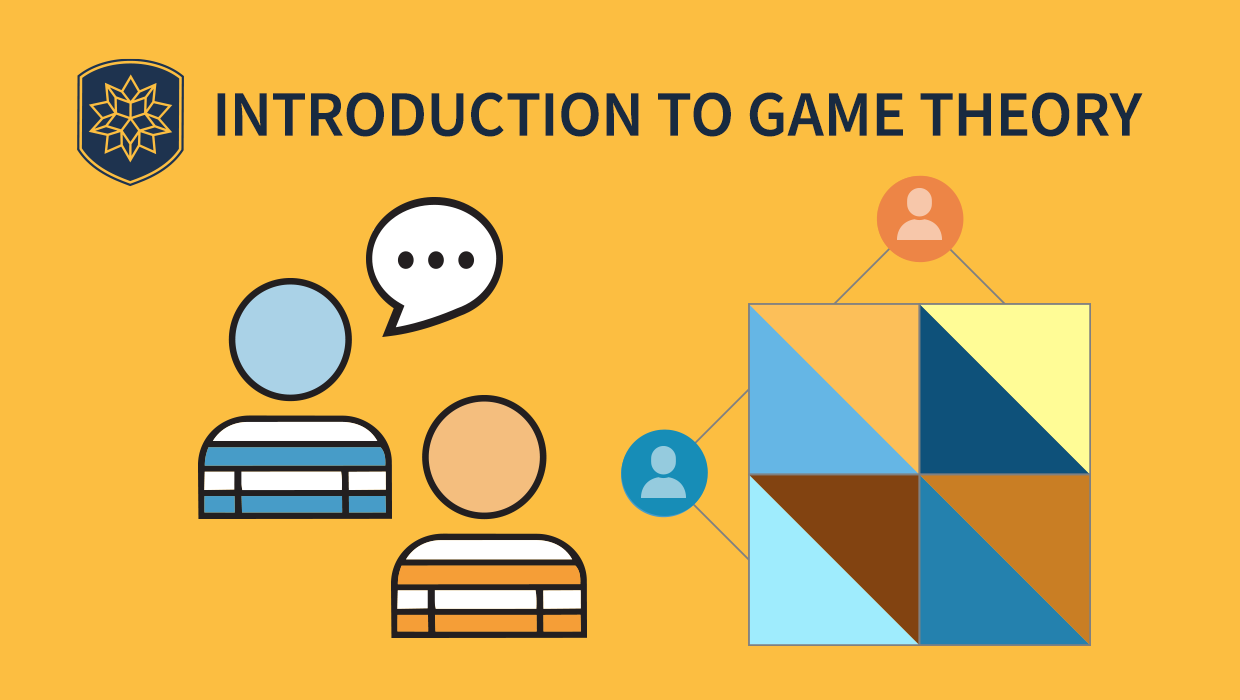
Clicking the following image will take you directly to the course, where you can instantly learn to play with game theory.

Motivation from History
Initially, mathematicians studied games to win bets and discover better game strategies. Girolamo Cardano is usually seen as the first to conduct a careful study of games of chance, with his Liber de ludo aleae (Book on Games of Chance), written around 1564. In terms of game theory as it is defined today, James Waldegrave analyzed the Le Her game. He solved an open problem by using a minimax mixed strategy in 1713. Eventually, economists like Antoine-Augustin Cournot and John von Neumann extended these ideas to all forms of decisions, particularly economic decisions. The term “game theory” was first coined in Neumann’s 1944 book Theory of Games and Economic Behavior. The axioms of game theory were formulated, establishing it as a field in its own right. This true formal start to game theory implies a major shift in scale. When a game can be as big as an economy, players are not necessarily human; monopolies, governments, corporations and many other institutions can also be players. In this context, the idea of a payoff is quite literal. Corporations will prioritize financial gain and minimize costs, leading to predictable actions. Together with the major contributions of John Nash in 1951, game theory was able to leap into popularity for mathematicians and economists alike.
Nowadays, professionals in economics, business strategy, political science, psychology and computer science use game theory to make and analyze decisions. Active areas of research in game theory include competition, cooperation, diffusion and stabilization of behaviors in biology, robotics and much more. Hunting patterns, migration and even human behaviors become explainable through game theory. Game theory has regained popular interest recently, with the mixing of game theory and computer science, known as the study of multi-agent systems. Behaviors may be simulated by intelligent agents, better known as bots, which constitute a large area of research under the umbrella of AI. As such, it has never been more important to learn game theory to make decisions rationally, computing for ourselves the best decision to avoid falling for AI-curated advertisements and predict the behavior of agents working against us, whether human, animal or, most importantly, artificial.
Overview
This course introduces fundamental concepts of game theory, specifically matrix games and tree games. All the material is crafted to give plenty of opportunities to deepen your understanding of the subject practically, through play, simulation, trial and error, and challenging questions. This will allow students to observe, analyze, explain, predict and design player behavior for any game.
Here is a bit of a sneak peek of the lesson contents:
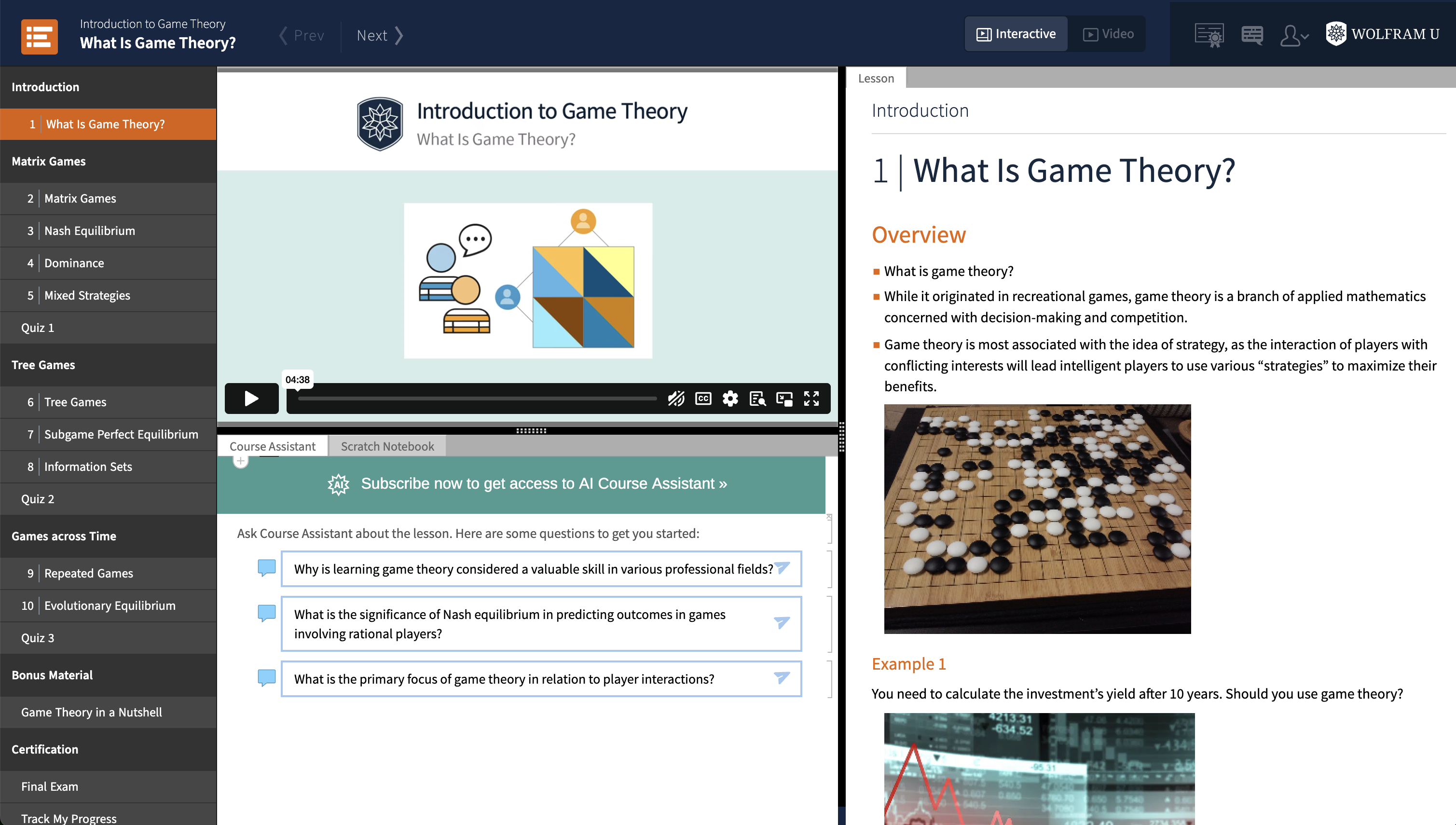
This course has 10 short video lessons. The order of lessons is only a suggestion, as each section can be studied independently. You will be able to watch all of the videos and complete the three short quizzes in two hours, but I recommend attempting all exercises and reading their solutions to cement your knowledge, which may take you an additional hour.
This course does not have any mathematical requirement. Anyone having minimal knowledge of Wolfram Language can excel. This course is aimed at beginners and provides prior knowledge needed for many courses in economics.
Now for a more detailed explanation of the course.
Lessons
This course is built around a collection of short lessons that aim to build the student’s capacity to formulate, simulate and solve decisions theoretically and computationally. This approach should enable you to apply game theory in daily decisions.
Here is a glimpse of Lesson 1, “What Is Game Theory?”:
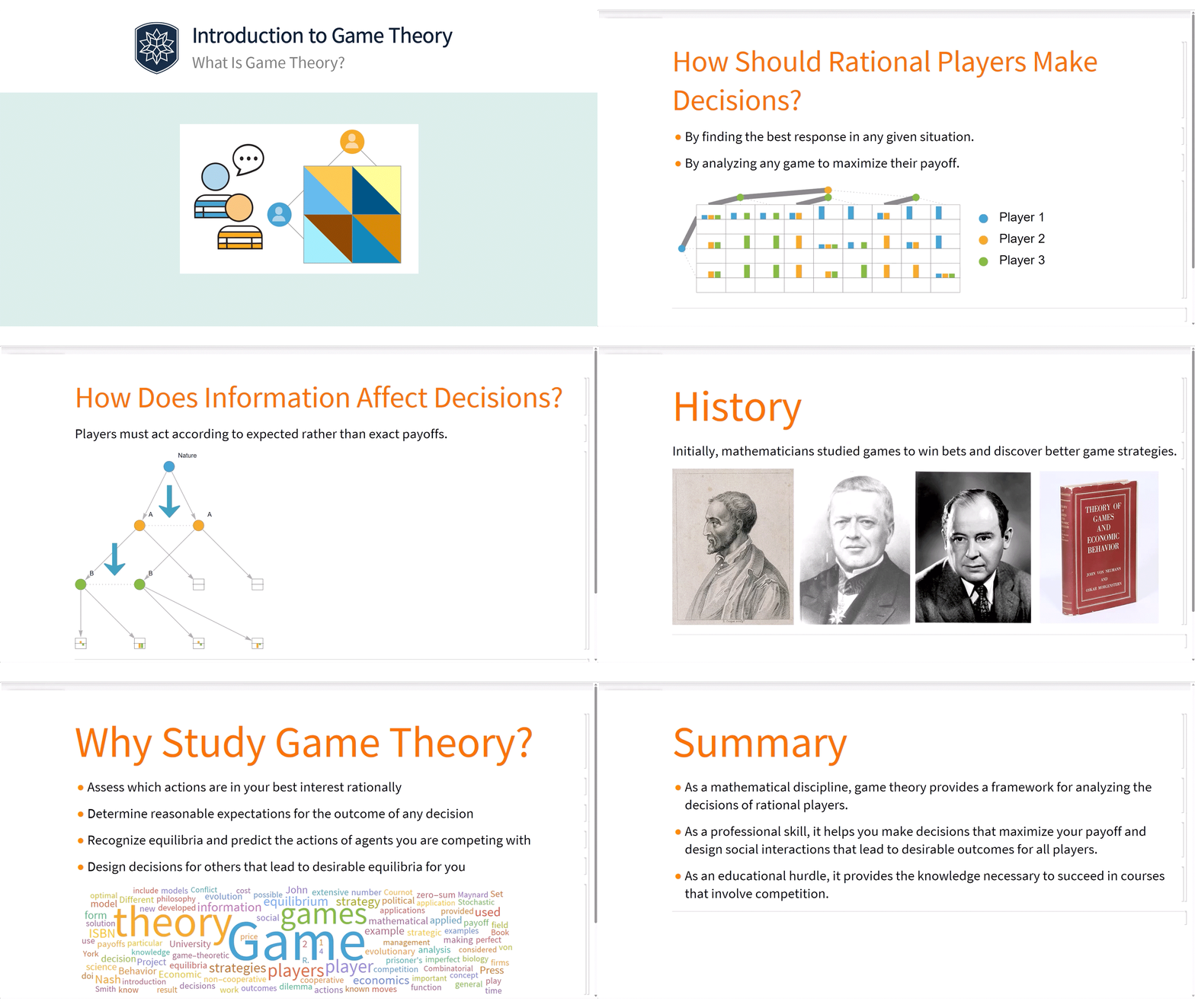
The full lesson notebook used in the video is also included, so you will have the code to try out the problems and interactive demonstrations for yourself. Any code in these notebooks can be copied with a simple click, and that code can be pasted into (and edited within) the scratch notebook area at the bottom of the course framework. For those with a Wolfram Notebook Assistant + LLM Kit subscription, the course also includes access to Wolfram AI Course Assistant, where you can get your questions about the lesson and computations answered in real time with immediate feedback.
Videos for each lesson are around eight minutes long, but length may vary depending on the requirements of the material—the “Repeated Games” video, for example, is the longest video at 12 minutes, as the concepts explained are harder and worth taking more time to iron out details.
Exercises
Additionally, each lesson, besides the introduction, has a separate set of 10 exercises. Exercises 1 through 9 are of similar difficulty, giving you many computational examples on which to apply the concepts seen in the corresponding lesson. All exercises also have solutions included. It is recommended to do exercises until the concepts are familiar to you:
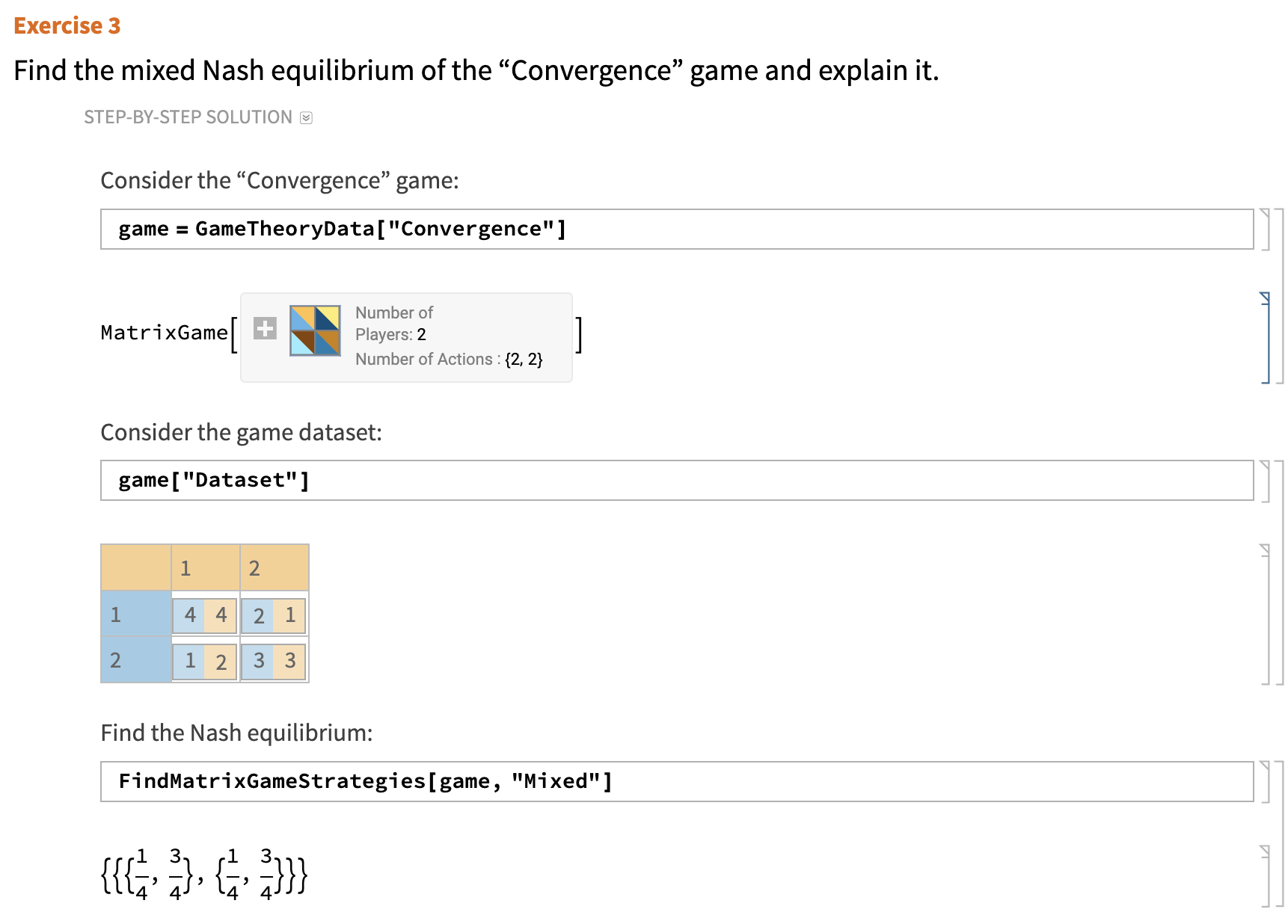
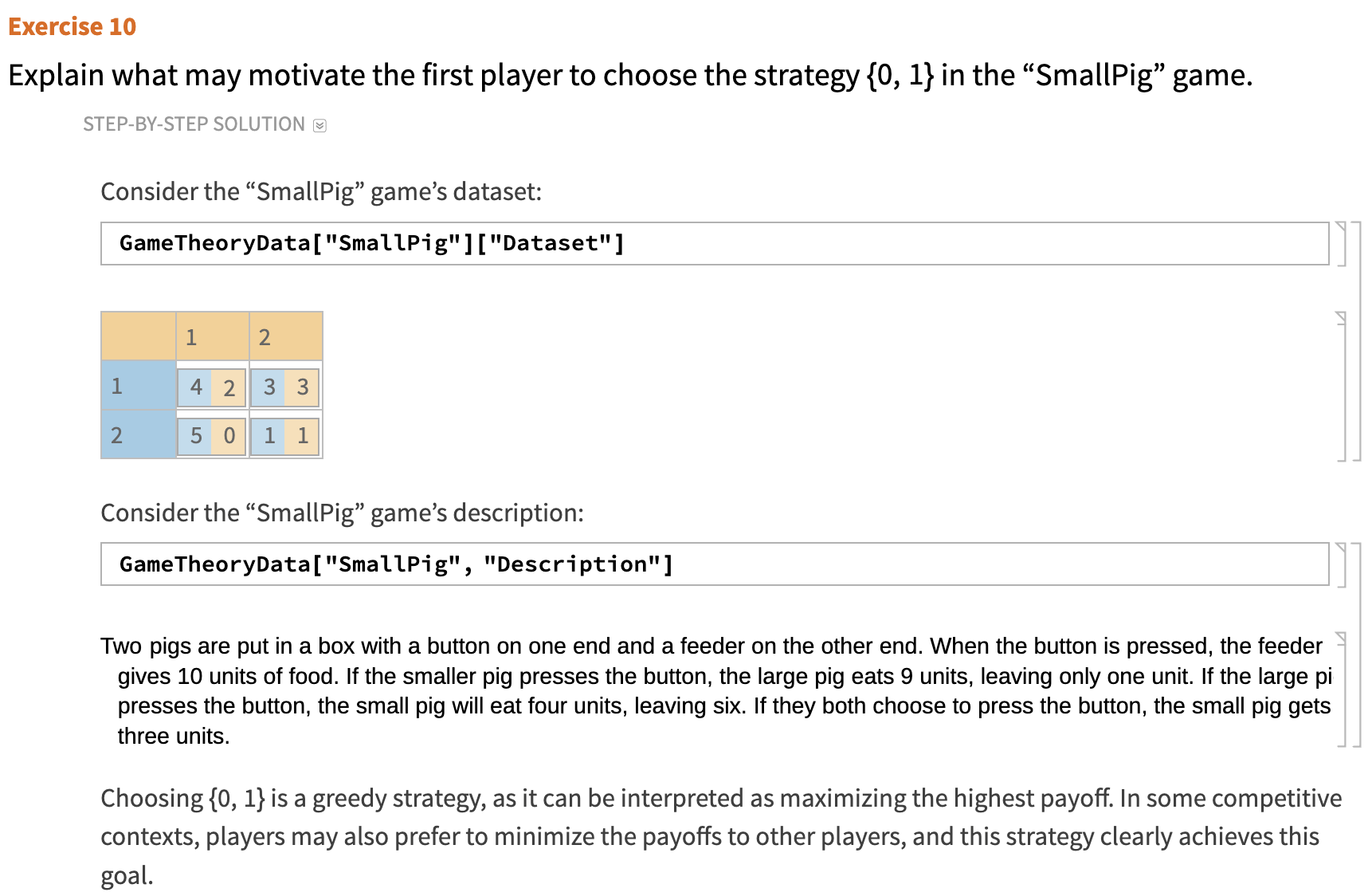
Exercise 10 is more theoretical, sometimes asking you to think outside the box, other times to give an opinion based on your developing intuition in game theory:
Resources
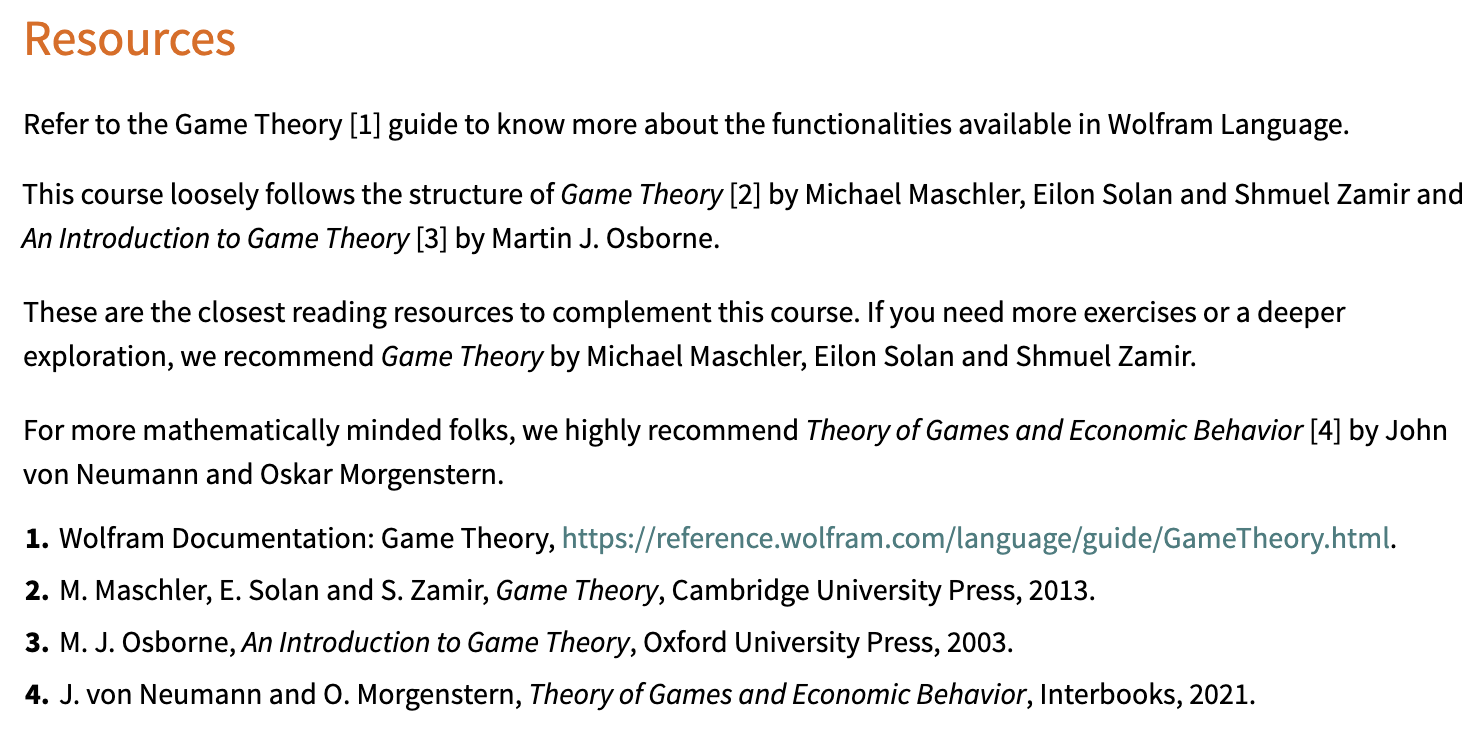
Every lesson ends with a resources section. This is meant for students who want to go beyond the course material. If the provided exercises are insufficient, many textbooks are given to provide more practice and deepen your understanding. For advanced computer science students or pure and applied mathematics students, this section provides useful comments and resources regarding the formal correctness of the concepts in the section:
Quizzes
Each of the three main sections in the course ends with a seven-question, multiple-choice quiz. Quiz questions are not as difficult as the exercises and aim to test your general understanding of the section. Anyone who does a few exercises and reviews their solutions will likely pass each quiz without difficulty:

Students receive instant feedback about their quiz question responses, and they are encouraged to try any method, including hand or computer calculations, to solve them.
Course Certificate
Students who wish to take advantage of everything this course has to offer will, by the time they complete it, have watched all 10 lessons and passed the three quizzes. At this point, students can access their certificate of course completion showing their knowledge in the field of game theory. This certificate can easily be added to your resume or shared in a social media profile.
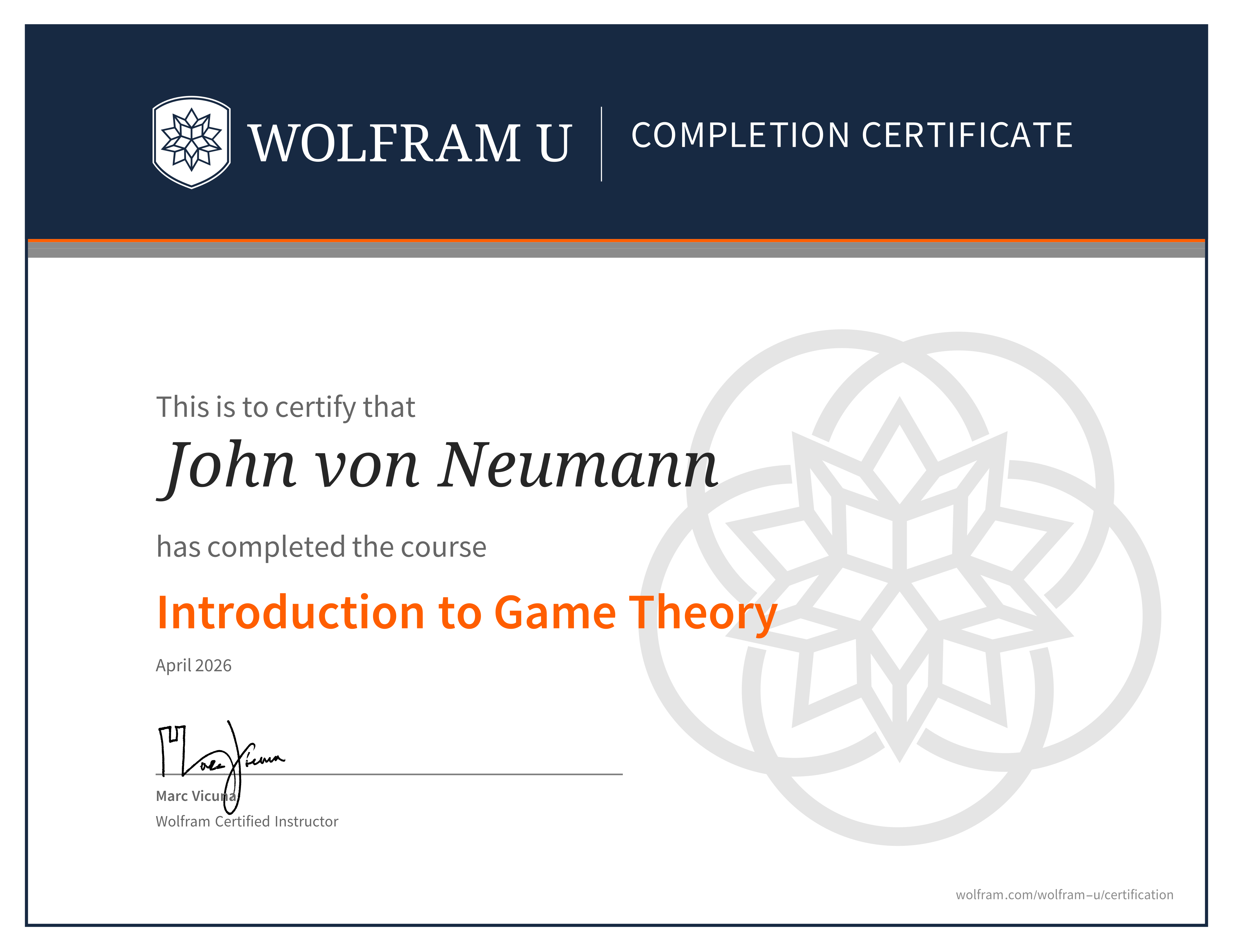
This course also has an optional final exam that you can take after completing all of the material. This final exam has more questions and a slightly higher difficulty than the quizzes, and, if you pass, you will receive a more advanced Level 1 certification for proficiency in game theory.
The Daily Study Group Preview
Wolfram U offered a glimpse of the course lessons and quizzes to Daily Study Group participants earlier this April, and we received some valuable feedback. Here is what participants said:
- “Many practical examples to integrate the concepts and the vocabulary.”
- “I’ve found the course very engaging and well structured. I especially appreciate how the intuition behind game-theoretic concepts is developed.”
A Building Block for Success
The applicability of the concepts in this course reach far beyond the domains mentioned, but the greatest strength of game theory lies in its day-to-day analysis of past and present conflicts and choices. If studied seriously, this Introduction to Game Theory course will provide you with the knowledge and intuition necessary to make decisions rationally and predict individual or societal behavior and help you in whatever field you choose to pursue. Just keep in mind:
“A proven theorem of game theory states that every game with complete information possesses a saddle point and therefore a solution.” — Richard Arnold Epstein
Acknowledgements
This course is the result of the work of the Wolfram U and mathematical computation teams. I would like to thank the Wolfram U, DQA, video and mathematical computation teams, with special thanks to Devendra Kapadia, Juan Ortiz and Anisha Basil for all the work they put into getting this course up and running.
| Register for one of Wolfram U’s Daily Study Groups. |

Comments