 News, Views & Insights
Quantum Computation for Research and Business
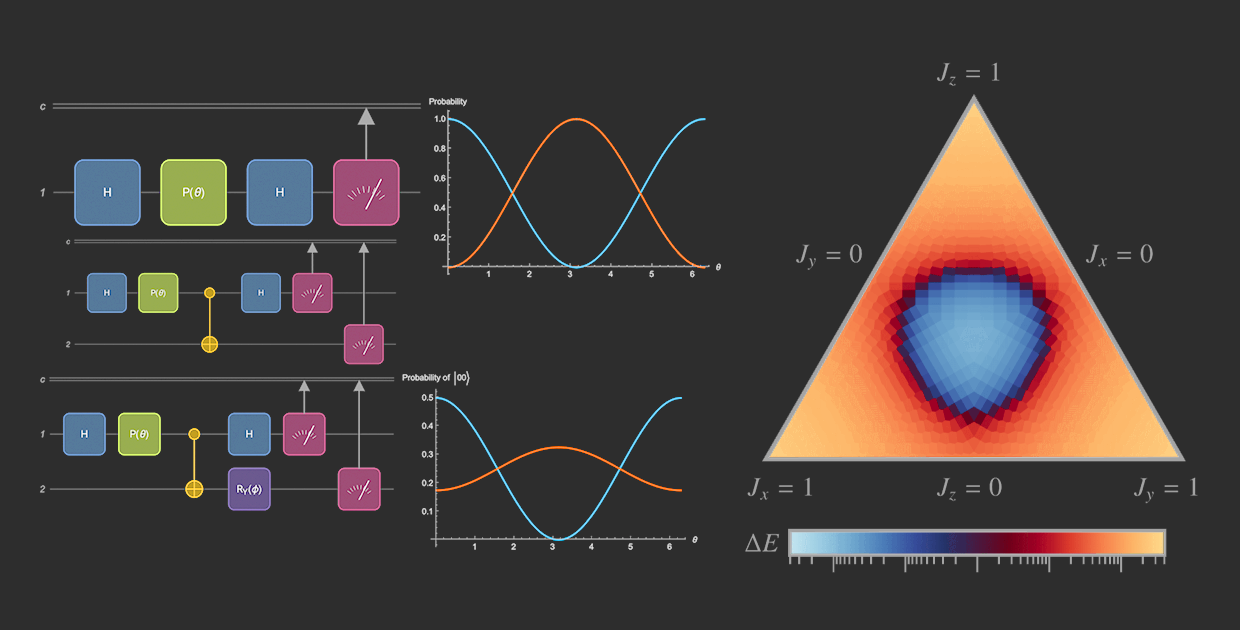
As quantum computing matures from theoretical promise to practical implementation, researchers in academia and industry gain access to new computational strategies for problems in optimization, simulation and algorithm design. Wolfram’s quantum tools provide an integrated environment to design, simulate and deploy quantum circuits within a single workflow.
Whether you’re brand new to computing in the world of quantum or exploring new quantum uses for your business, take advantage of these resources for learning, creating and utilizing quantum science and technology with Wolfram Language.
- Tools for Learning Quantum Computation »
- Quantum Projects for Researchers »
- Quantum Resources for Businesses »
Tools for Learning Quantum Computation
Quantum computing takes advantage of the unusual mathematics of superposition and entanglement, where interference among amplitudes does the real computational work. No specialized hardware is required to begin exploring this arithmetic; simulation environments and cloud-based quantum processors now make the essential ideas accessible to anyone willing to think carefully about states and measurements. If you’re new to quantum science and technology, check out Wolfram’s educational resources.
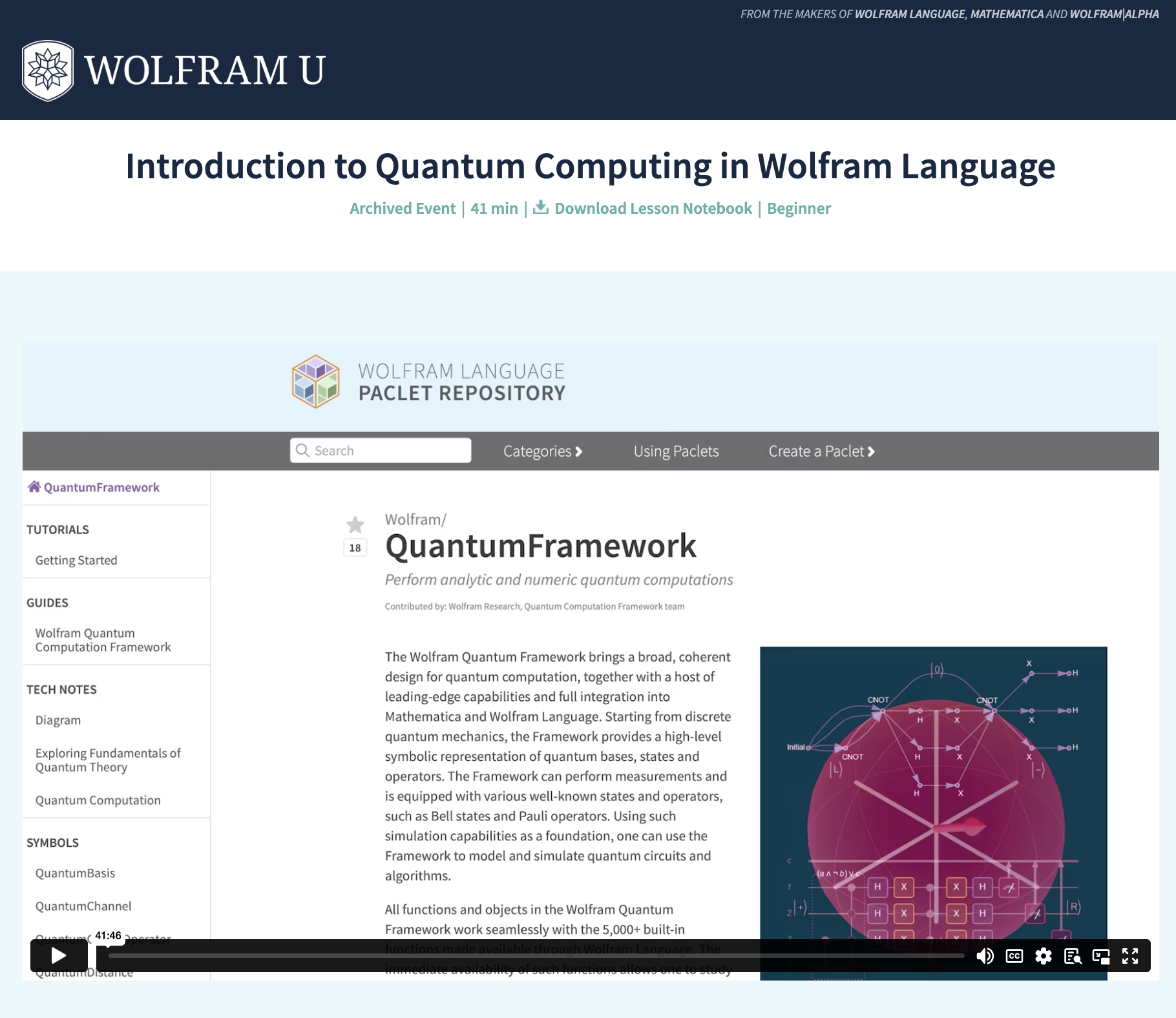
Wolfram U—Introduction to Quantum Computing in Wolfram Language
Presented by one of our in-house quantum experts, Introduction to Quantum Computing in Wolfram Language discusses the basic principles of quantum mechanics and how it extends to the world of traditional computation using Wolfram Language. Explore the Wolfram Quantum Framework and its functions and basic quantum computations, circuits and more.
Wolfram YouTube—Quantum Development and Education
Quantum science and technology comes with a rich history of research and development. Learn more about the history and current state of quantum science and technology.
In this 45-minute-long excerpt from his Q&A livestream series History of Science & Technology, Stephen Wolfram explains the history of quantum mechanics starting with the ancient idea of discreteness and its applications in the physical sciences. Also featured in the full episode is a much more brief description of Schrödinger’s cat.
The Wolfram Academic Innovation Support Team hosts members of QuSTEAM to discuss their efforts to promote quantum education and development.
This collection of archived Wolfram U study group sessions walks through the Wolfram Quantum Framework and the essentials of quantum computing—from defining quantum states to computing with circuits. Totaling to five and a half hours, this video series is more intensive than the aforementioned Introduction to Quantum Computing in Wolfram Language.
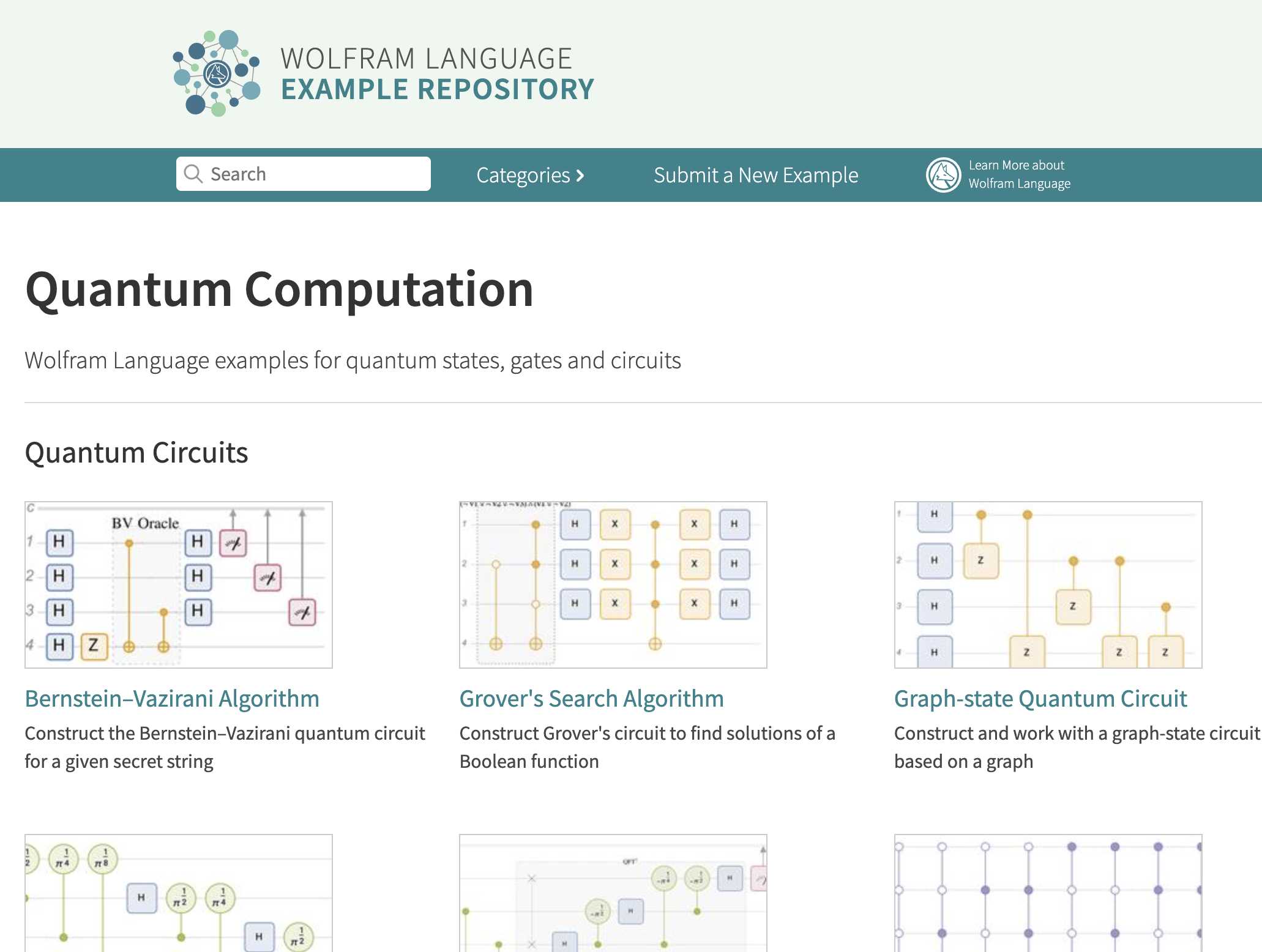
Wolfram Language Example Repository: Ready-Made, Interactive Quantum Examples
Learning quantum computing from scratch might feel daunting, but the Wolfram Language Example Repository contains more than 30 ready-to-use examples of quantum states, gates and circuits to experiment with and learn from. Each example contains a small introduction to the example and a walkthrough with Wolfram Language code ready to be copied and pasted into your own notebook.
Working in the Wolfram Quantum Framework
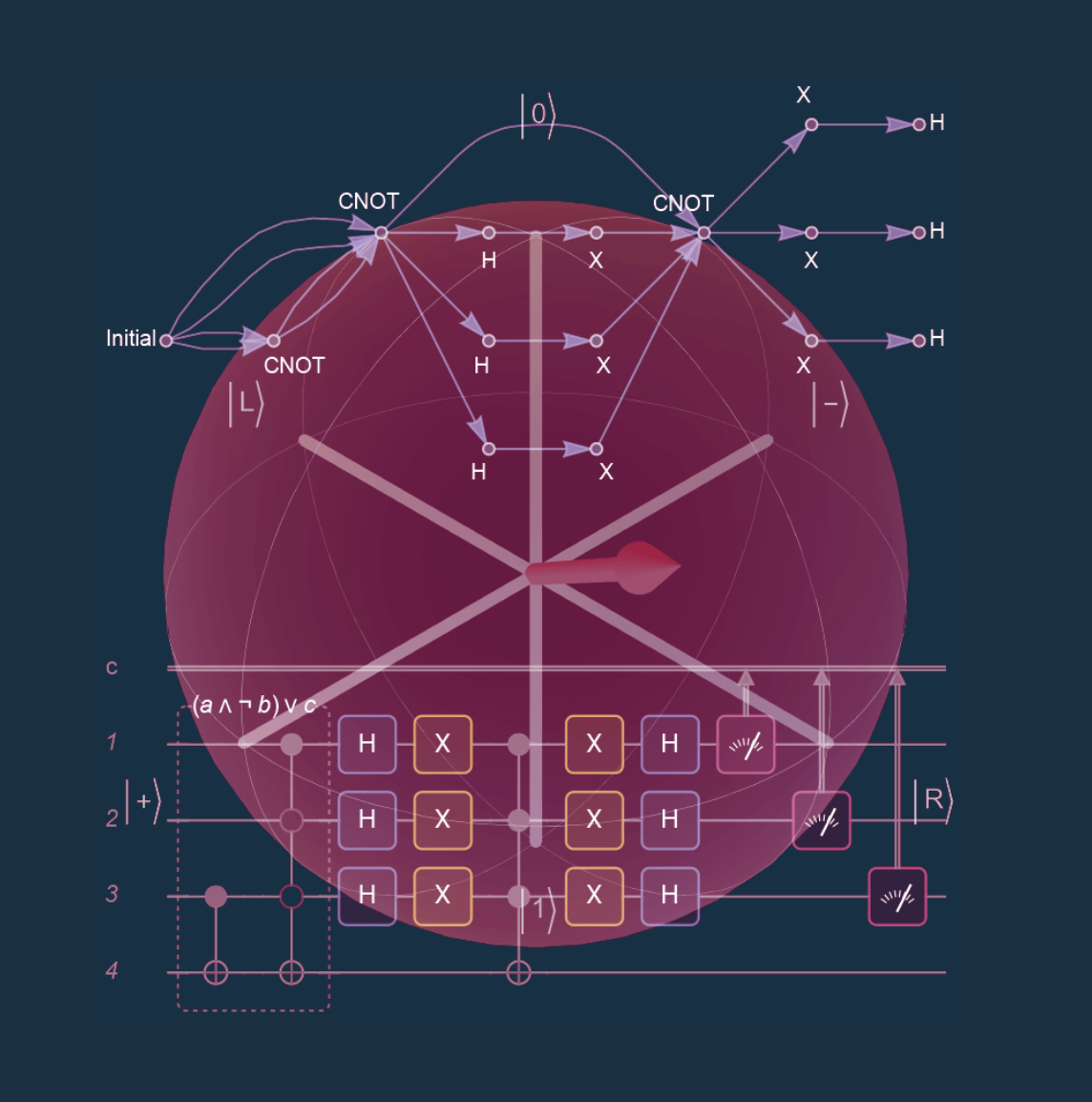
Once you’re ready to start creating your own projects, the Wolfram Quantum Framework is where the magic happens. The paclet pages contain full instructions for loading the paclet, native functions, guides to interoperability with external quantum platforms and more.
For Educators
Wolfram U—Wolfram Quantum Framework: A Guide for Educators
For the educators expanding their syllabi and introducing students to the world of quantum, the video Wolfram Quantum Framework: A Guide for Educators is available. Led by a mix of Wolfram quantum experts and members of the Academic Outreach Team, this livestream covers basic concepts of quantum computation, including quantum states, transformations, algorithms, operators, gates, circuits and using the Framework with Wolfram Language.
Wolfram Demonstrations Project: Quantum Projects
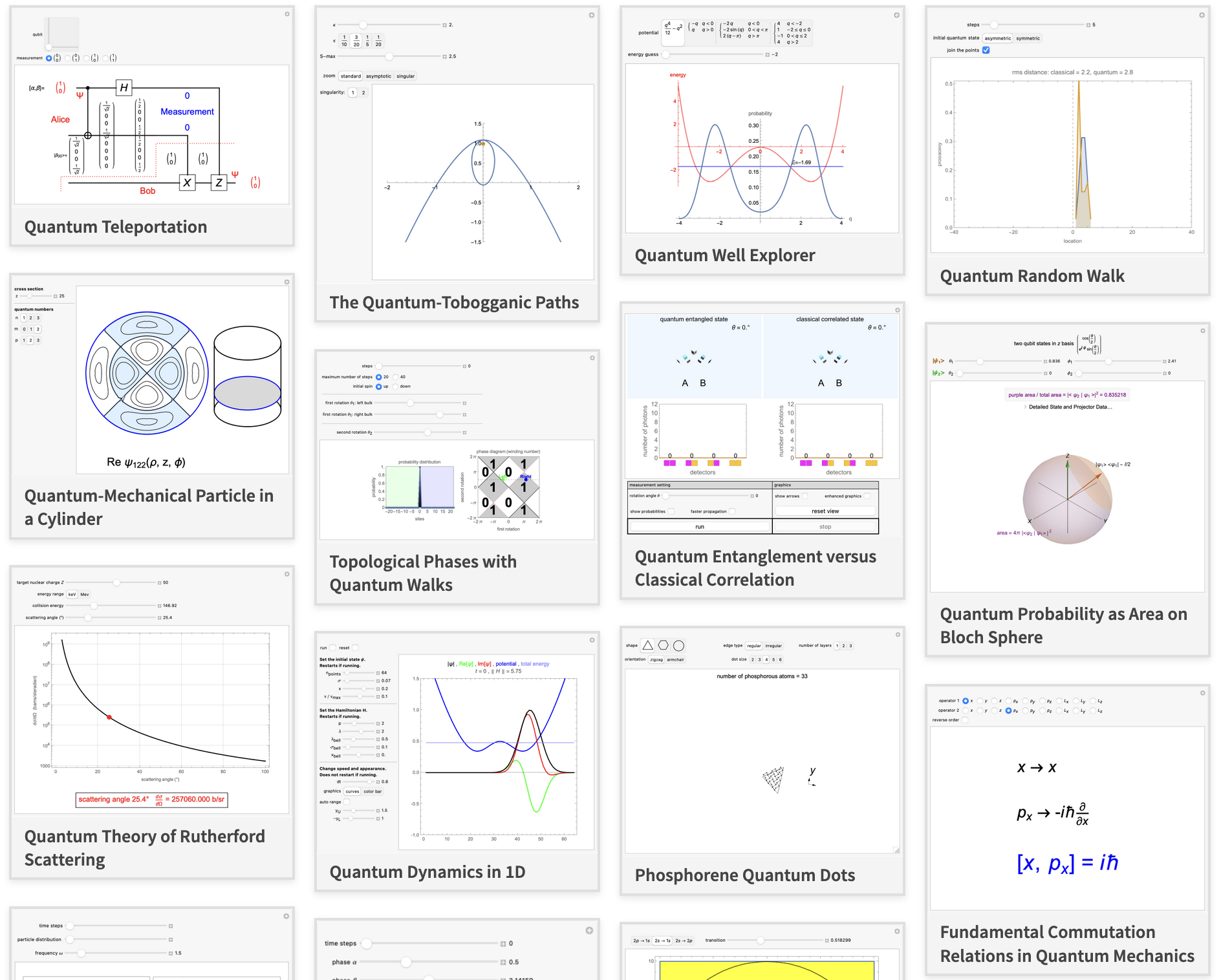
Looking for the perfect illustrations to complete your quantum lesson plan? The Wolfram Demonstrations Project contains nearly 550 interactive quantum projects. Each project includes an explanation of the project and an interactive sandbox to manipulate the tools on the webpage—no notebook required! Options to copy and paste the Manipulate, access the notebook in the Wolfram Cloud or download the notebook are available as well.
Quantum Projects for Researchers
Quantum tools with Wolfram Language are nestled in a comprehensive research infrastructure—everything from computation, circuit construction, hardware analysis, visualization, optimization and more. Theoretical work becomes streamlined so you can focus on the big picture. See what’s in development for quantum science and technology from the Wolfram team and fellow power users.
Contribute to Wolfram Quantum
For a behind-the-scenes look at what’s next for quantum at Wolfram, check out the Wolfram Quantum Framework GitHub, where the Wolfram Quantum Team and power users can contribute to the paclet and see what’s in store for future and current courses.
You can also share your unique functions, tools and projects directly to Wolfram repositories to be reviewed by the Wolfram team.
- Wolfram Function Repository Submission Notebook »
- Submit to the Wolfram Language Paclet Repository »
- Wolfram Language Example Repository Submission Notebook »
- Wolfram Demonstrations Project Submission Notebook »
Wolfram Media Books
Quantum Computing by Model and Simulation: A Computational Approach
by Mohammad Bahrami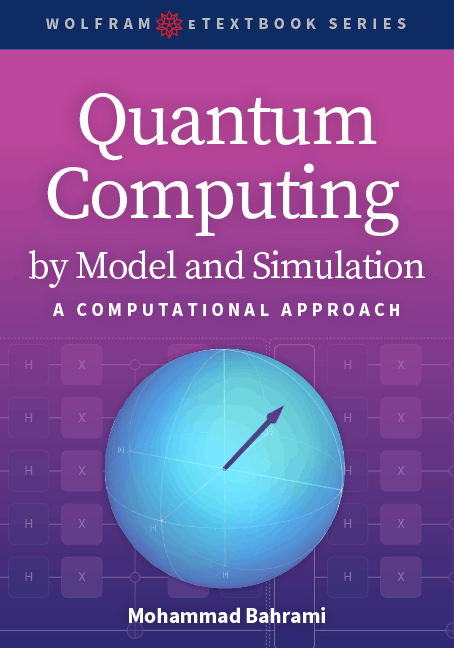
In his second book, Bahrami introduces quantum computing through its essential concepts, principles and foundational algorithms, developed via guided modeling and simulation exercises. The emphasis throughout is on executable code and direct computational engagement with quantum systems so that the formalism is learned by doing rather than by passive reading.
Scattering Amplitudes in Quantum Field Theory
by Simon Badger, Johannes M. Henn, Jan Plefka and Simone Zoia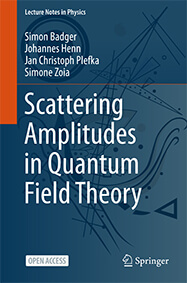
“This open access book bridges a gap between introductory Quantum Field Theory (QFT) courses and state-of-the-art research in scattering amplitudes. It covers the path from basic definitions of QFT to amplitudes, which are relevant for processes in the Standard Model of particle physics.”
A Primer on Quantum Chemistry
by S.M. Blinder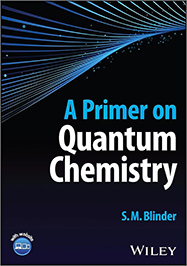
The quantum wave leaves no discipline neglected—Blinder’s A Primer on Quantum Chemistry answers the call to apply quantum mechanical principles to the study of chemical systems to understand quantum effects at the atomic and molecular level.
Wolfram Community Posts—Practical and Curious Quantum Projects
Wolfram Community features projects, tools and guides to computing with Wolfram Language. Publish your own work, connect with fellow power users or take inspiration from the quantum computing group.
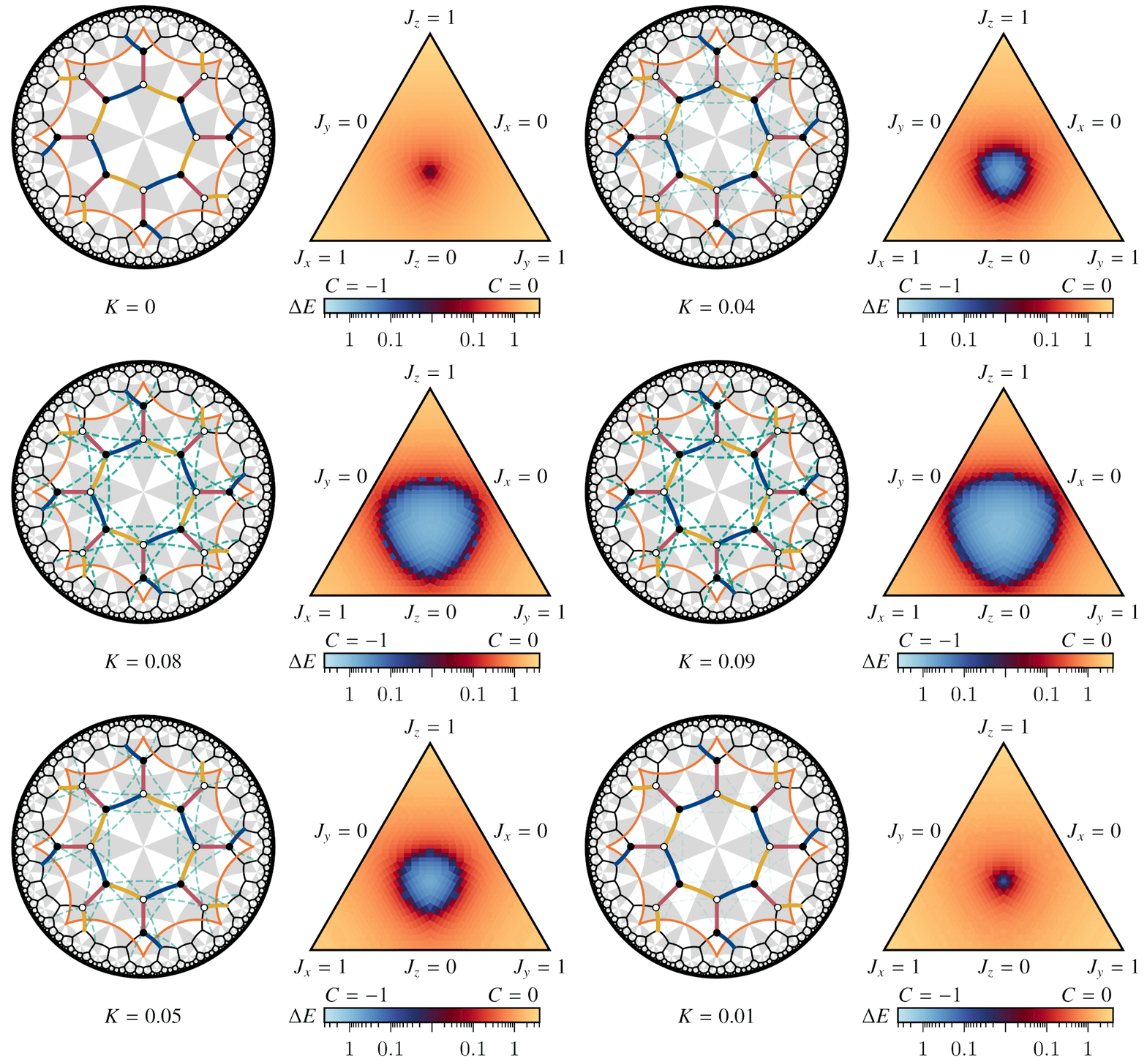
Hyperbolic Spin Liquids
by Patrick M. Lenggenhager
Lenggenhager demonstrates how to use hyperbolic band theory to obtain the ground-state phase diagram on one of them and study the phases therein, with a focus on the exotic spin liquid with low-energy density of states.
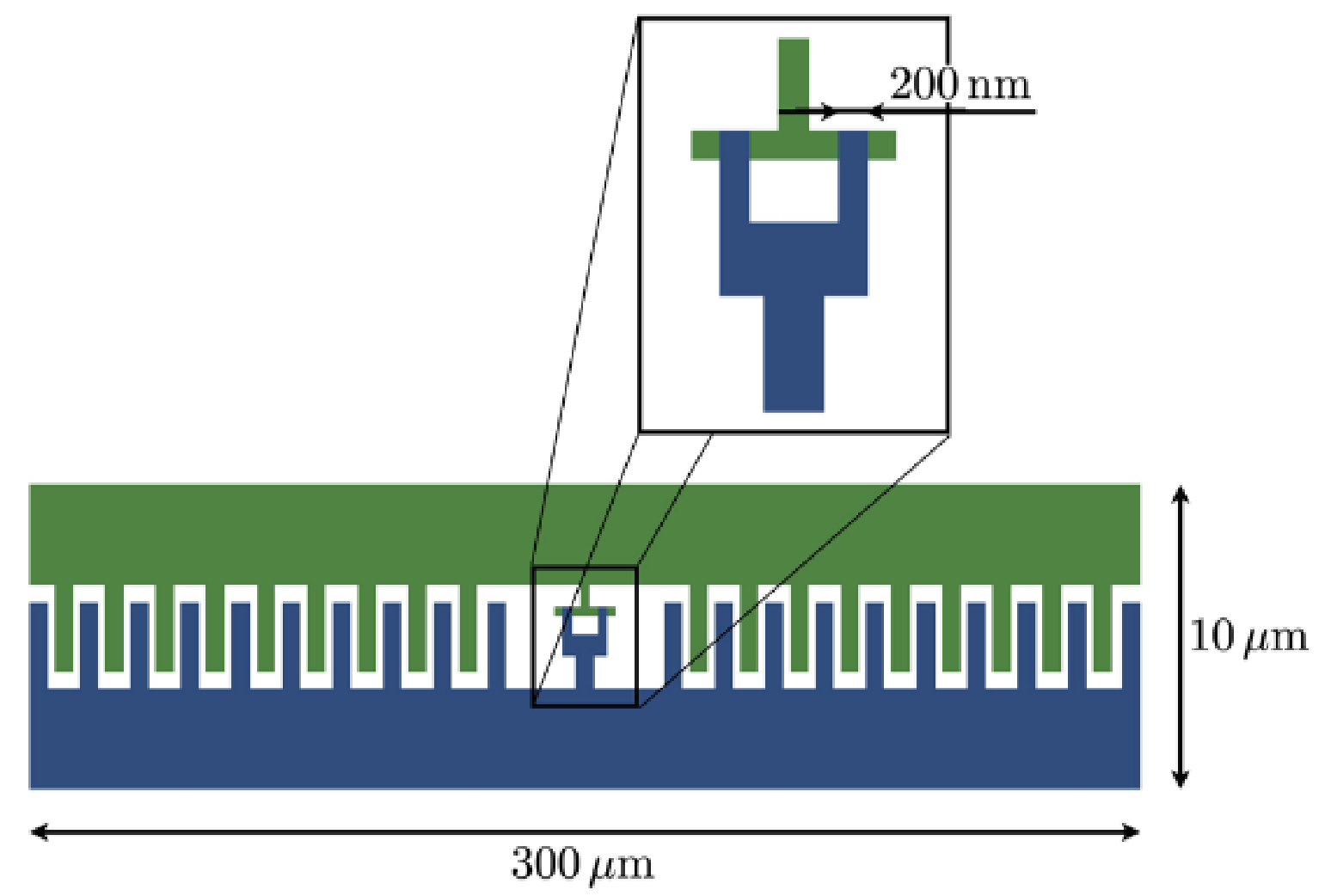
Transmon: A System for Superconducting Quantum Computers
by Mahn-Soo Choi
Choi uses Wolfram Language to develop a transmon, a superconducting charge qubit variant to reduce sensitivity to charge noise. Choi is also a 2025 Wolfram Innovator Award winner for his work in quantum and physics education.
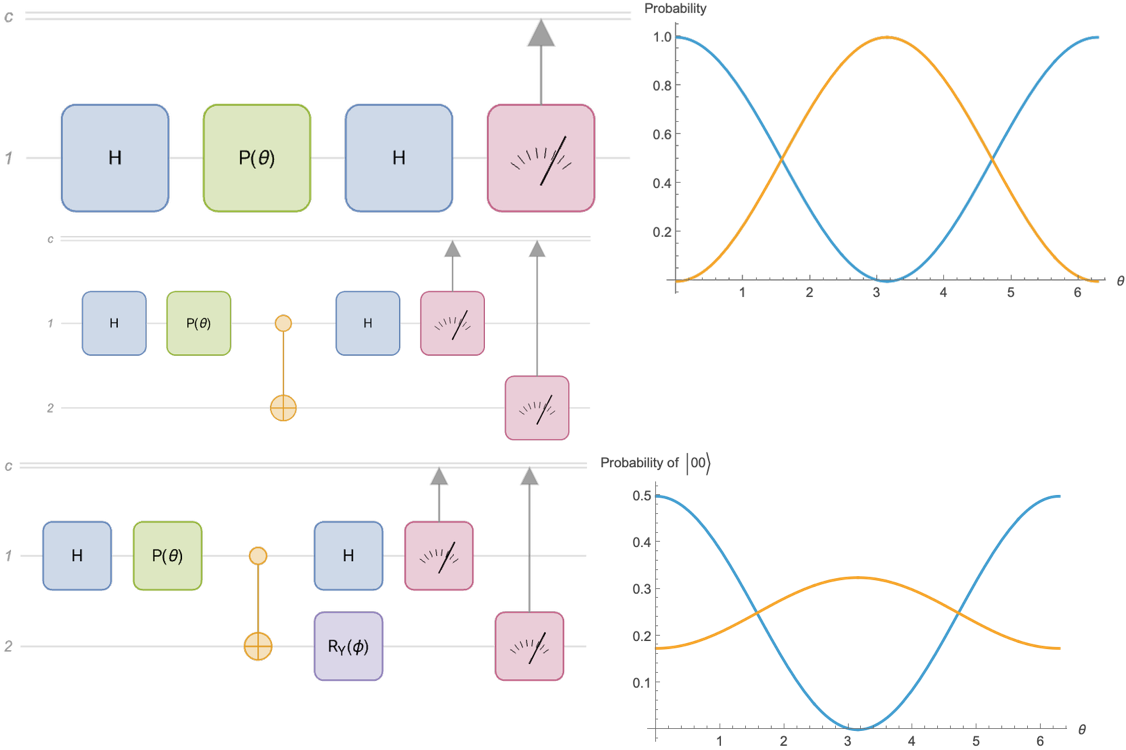
Quantum Interference Loss via Path Encoding and Recovery by Quantum Erasure
by Mohammad Bahrami
Bahrami examines which-way experiments through quantum computation and shows how quantum erasure recovers the interference pattern that path information destroys. The discussion connects naturally to complementarity and Bohr’s account of mutual exclusivity between wave and particle descriptions.
Wolfram Tech for Your Research
The Wolfram Tech for Your Research page exists to recognize thousands of featured Mathematica citations in research across disciplines, including more than 140 quantum papers. See how Wolfram is being used in advancing research:
- No Quantum Advantage without Classical Communication: Fundamental Limitations of Quantum Networks »
by Justus Neumann et al. - Mode-Sum Prescription for Renormalized Expectation Values for a Charged Quantum Scalar Field on a Charged Black Hole »
by Cormac Breen et al. - Quantum Chemical Investigation of Polychlorinated Dibenzodioxins, Dibenzofurans and Biphenyls: Relative Stability and Planarity Analysis »
by Sopanant Datta and Taweetham Limpanuparb
Wolfram Conversations
Fault–Tolerant Quantum Computing
The Wolfram Academic Innovation Support Team and a panel from QuEra Computing and Harvard University discuss quantum computing advancements, quantum error correction and the technical innovations and challenges in their respective works.
Toward Fault–Tolerant Quantum Computing
The Wolfram Academic Innovation Support Team and experts from Q-CTRL discuss insights into fault-tolerant quantum computing and strategies to reduce quantum noise with the partnership between Q-CTRL’s Fire Opal and Wolfram.
Bridging Quantum Computation and Practice with Wolfram Language
Explore various facets of quantum computation through the lens of the Wolfram Quantum Framework. Our in-house quantum experts focus on the conceptual groundwork of quantum computing, such as tensor networks, phase space and stabilizer formalism, and delineate how these are implemented within Wolfram Language.
FeynCalc | Quantum Field Theory Package
This video showcases FeynCalc, a package created for symbolic evaluation of Feynman diagrams and algebraic calculations in quantum field theory and elementary particle physics. Creator Vladyslav Shtabovenko walks through how to use FeynCalc and its use cases.
Wolfram Virtual Technology Conference 2025
Every fall, Wolfram is proud to host our virtual technology conference—where Wolfram Language power users present their technological discoveries and projects and commune with fellow innovators. The 2025 conference included several quantum presentations. Keep an eye out for this year’s registration for attendees and presenters!
Sebastian Rodriguez presents an introduction to the quantum approximate optimization algorithm (QAOA) and quadratic unconstrained binary optimization (QUBO) formulation through the max-cut problem using the Wolfram Quantum Framework.
Aninda Sinha, a 2025 Innovator Award winner, presents an infinite family of new π formulas, parameterized by elasticity. In the large-elasticity limit, it recovers the Madhava series, also yielding many new identities.
Quantum Resources for Businesses
Whether you’re looking to streamline R&D or ready to launch a new product line with quantum support, Wolfram’s quantum tools come from nearly 40 years of mathematics and scientific development to support technical research and business development.
Wolfram Quantum Commercial Collaboration
Wolfram’s quantum technology is in action for startups, corporations and professional research labs all over. See how Wolfram collaborates with and supports businesses with their technological advancements and streamlines operations for them:
Learn what Wolfram is doing in the world of quantum and how have we revolutionized the game by combining Wolfram Language and hardware service providers.
A unified solution for the development of quantum and classical algorithms featuring Wolfram Language and Classiq’s engine in this recorded webinar session.
A discussion between the Wolfram Academic Innovation Support Team and developers from Classiq on application areas and how to use Qmod for abstracting quantum algorithms.
Read about Wolfram’s partnership with Q-CTRL’s Fire Opal to suppress gate errors and mitigate noise-induced decoherence in quantum processing units.
The Wolfram Academic Innovation Support Team and Stuart Flannigan of Strangeworks discuss creating user-facing tools for solving problems using quantum circuits, classical simulators and quantum-inspired solvers.
Wolfram Quantum Tools
Wolfram Language’s quantum tools start at the Wolfram Quantum Framework. The tool page includes tips on how to use the built-in quantum tools and guides for specific uses, such as quantum optimization or computation.
The Framework exists within the Wolfram Language Paclet Repository, which includes a host of other quantum paclets to support quantum computation in Wolfram Language, including:
This package contains compilations of Wolfram Language demonstrations for quantum information systems, quantum many-body systems and quantum spin systems.
A series of functions for users to submit quantum circuits to quantum hardware through the Strangeworks platform.
This package combines the power of Wolfram’s chemistry tools and quantum mechanics capabilities to create electronic structures.
What Will You Compute?
While practical quantum computing may not be mainstream yet, technological research continues onward in establishing the foundations of quantum science and technology. The development of quantum will push sciences of all disciplines further, and Wolfram will continue to commit to all pursuits of computational X.
Comments