 News, Views & Insights
Most-Viewed People on Wikipedia in 2025 How Catalyst Events Imprint Social Memory
On January 15, 2026, Wikipedia turned 25, and that birthday demonstrates a simple, radical fact: a vast, volunteer-built reference work that stays free to read has become a foundational record of human knowledge and an infrastructure for how the internet answers questions, quietly propping up organic learning, search engines, voice assistants and generative AI. In 2025, one attention-economy tactic got a mainstream label: “rage bait” (the official Oxford Word of the Year 2025)—online content deliberately designed to elicit anger or outrage. It was also a year of conflict, political upheaval and extreme weather, the kind of backdrop that turns public life into a sequence of jolts. And yet when people wanted context, not reaction, they kept choosing the same destination. The Wikimedia Foundation estimates that in 2025, people spent about 2.8 billion hours reading English Wikipedia, and the year’s most-read pages sketch a tight portrait of what pulled us hardest: politics, popular culture and loss.
 Engage with the code in this post by downloading the Wolfram Notebook
A year like that raises an old question: what turns a headline into a memory? A quick intuitive thought provides an obvious answer—a catalyst event emerges and attention spikes. The full mechanism is subtler. Some spikes burn off fast (think of it as ephemeral attention). Others leave a residue and reset the baseline, leaving a higher new normal of attention that lingers after the news cycle moves on and generates new records and information restructuring (long-term social memory). Wikipedia pageviews are unusually useful here because they are open, topic specific and language specific, making it closer to recorded attention than the metrics platforms choose to publish. In what follows, I use Wikipedia pageviews to map the most-viewed people of 2025 and to show, with data, how catalyst events imprint social memory.
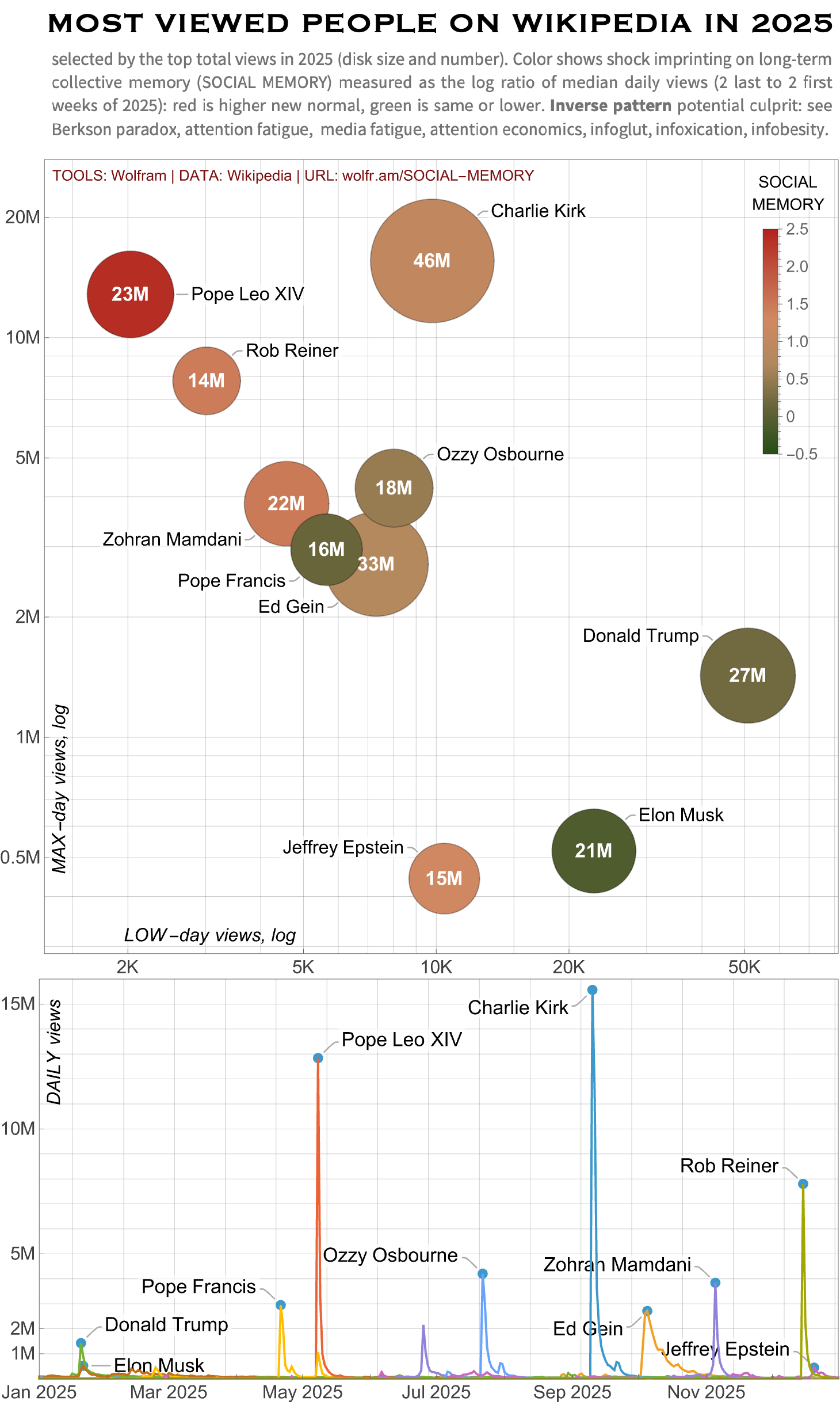
People in this chart were selected by the Wikimedia Foundation based on the total annual pageviews of their corresponding Wikipedia articles in 2025. These totals are reflected by the disk size and number in its center. The bottom plot is a time series of daily page hits during 2025 for all people in the top chart. Almost all articles feature a significant peak due to an event that caused viral news and media coverage. The stark heights of the peaks, while striking, hide visually a crucially important part of the plot—the views for run-of-the-mill days—the non-viral baseline. That background is a key component for identifying the phenomenon of societal or social memory.
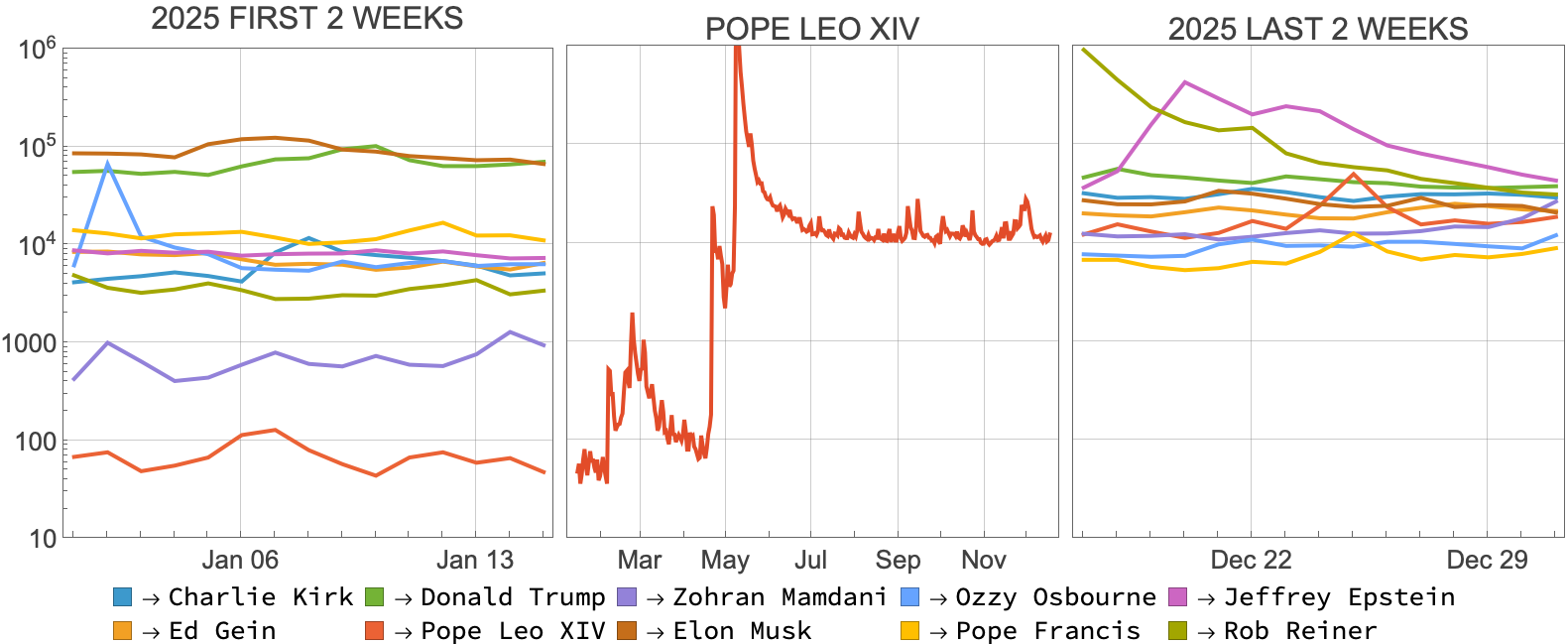
Log scale allows zooming in on typical baseline views like the three panels shown below. And immediately a surprising pattern becomes obvious: between the start and end of the year, some baselines almost did not move and some changed hundred-fold. That motion of the baseline is formation of social memory rooted in creating public records and restructuring the connectome of information. A deeper look reveals another pattern: the baselines stayed the same for people of high fame (like Donald Trump or Elon Musk) and moved significantly for little-known individuals that got discovered, like Robert Francis Prevost, who became the head of the Catholic Church, Pope Leo XIV. It is almost like the notion that memory forms only for things we do not yet remember… quite obvious once verbalized, but striking to witness in data.
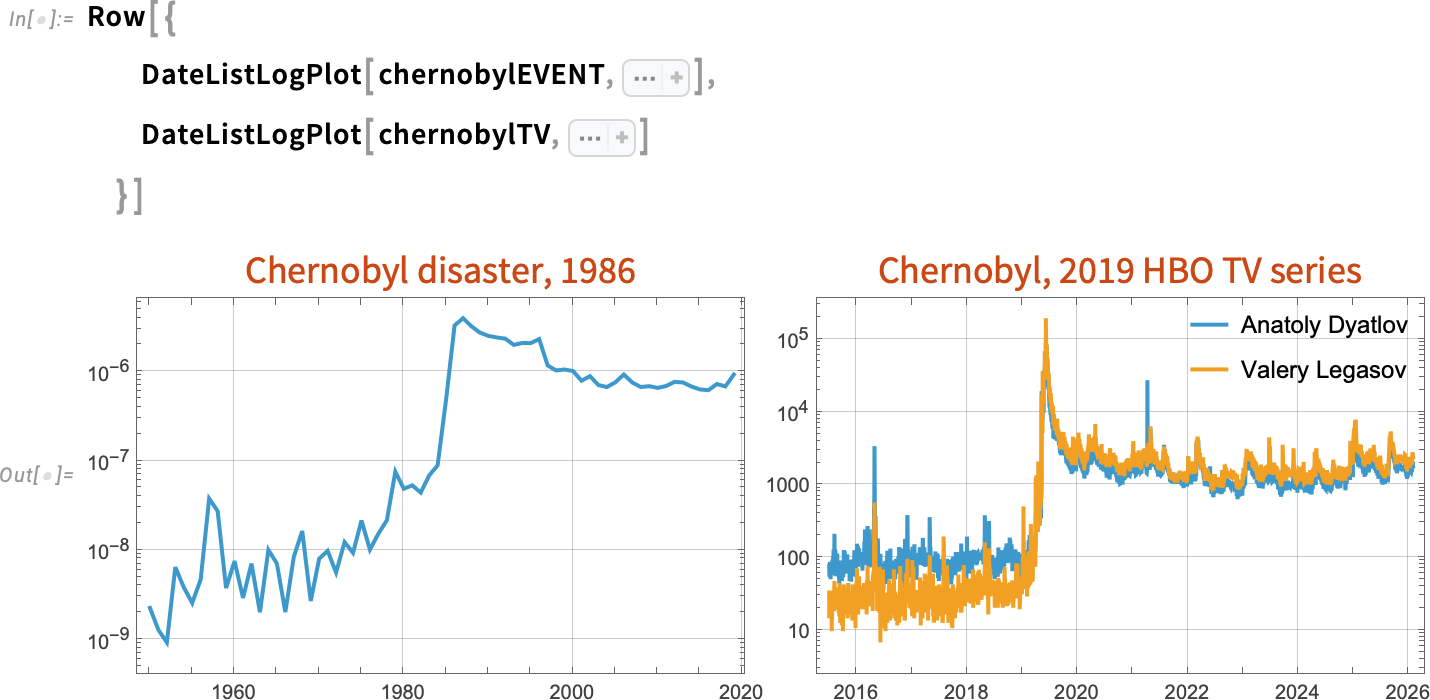
The phenomenon of shifting the baselines after a catalyst event is universal and ubiquitously present in various types of data. Moreover, one powerful event can have many echoes, continuing to restructure human records long after it has passed. For example, when the Chernobyl disaster (a nuclear power plant explosion) happened in Ukraine in 1986, the event had such global impact that the word “Chernobyl” changed its use frequency in the English language by orders of magnitude:

Three decades later, the eponymous 2019 HBO historical TV series featured the real-life people Anatoly Dyatlov (nuclear engineer) and Valery Legasov (chemist), dramatically changing the baseline of views for their Wikipedia pages:

Wolfram Language is uniquely positioned to explore such phenomena as it accumulates diverse records as built-in data and allows instant analysis and visualization:
The baselines are well estimated by medians, and if those for the end and start of the year are plugged into a log ratio, one gets a quantifiable social memory change measure:
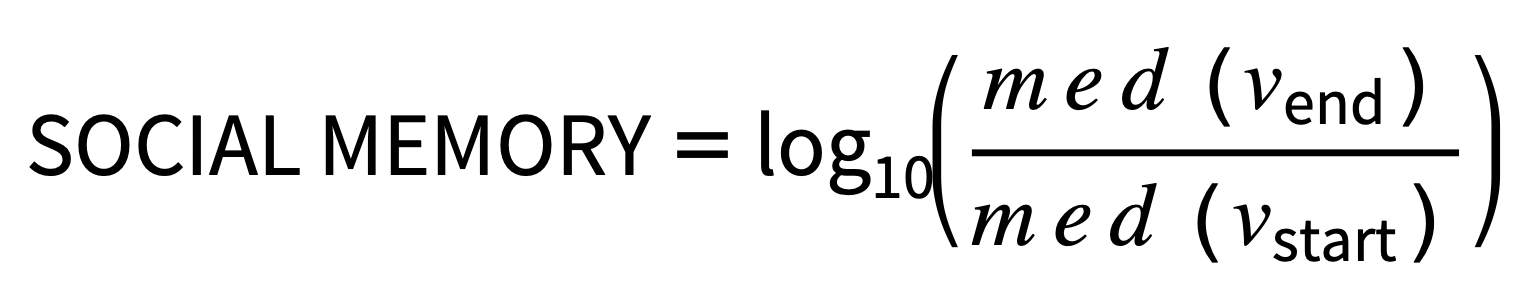
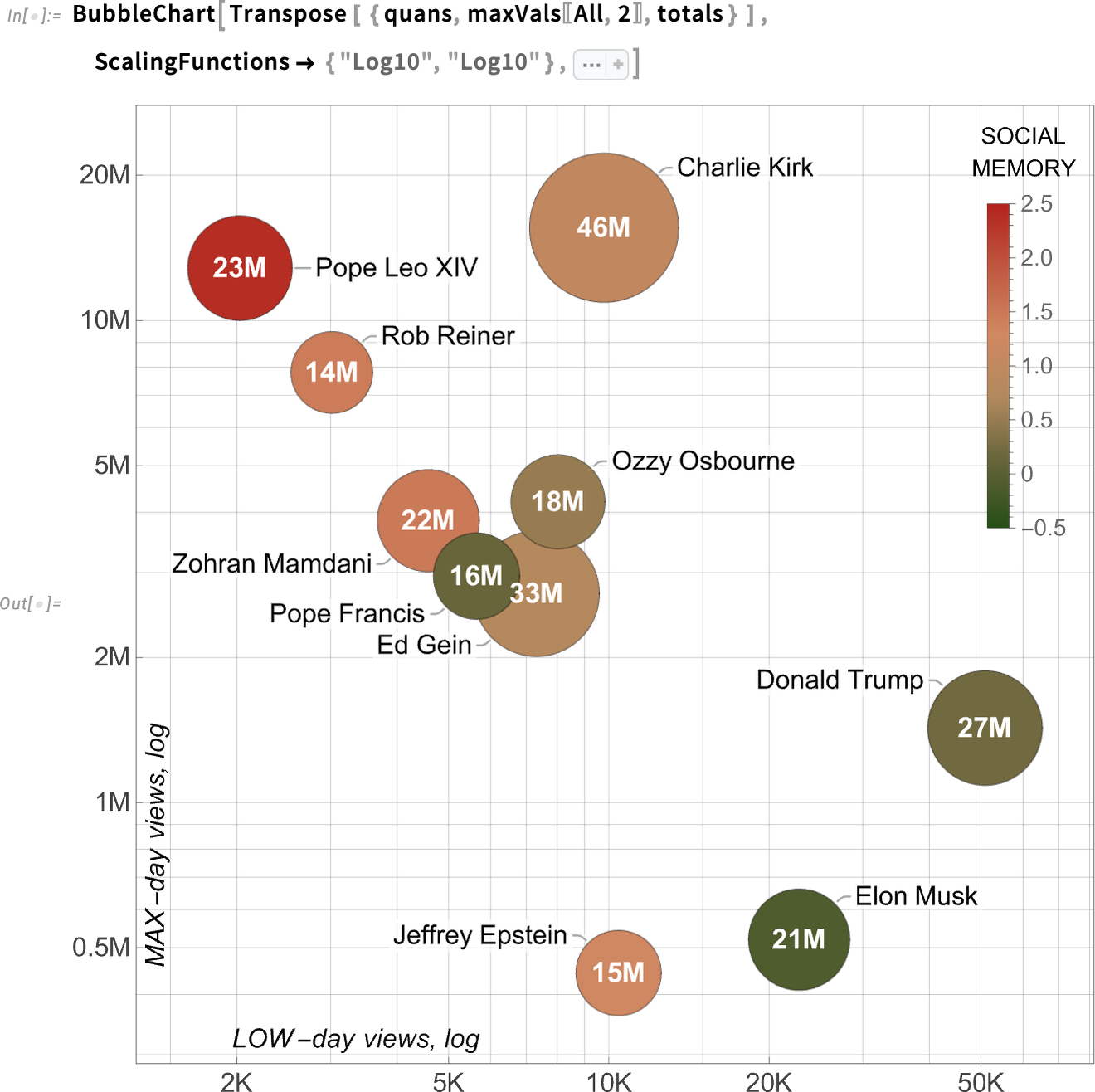
This quantity defines the color of the disks in the top chart. The trend now emerges more clearly: the lower the baseline (low-day views), the higher the memory imprint. Fresh impressions have greater capacity to imprint on social memory.
But why is there also such an obvious inverse trend for the top-viewed people—the more they are in the public conversation every day (x axis), the lower their viral peak (y axis)? The answer might be many fold. A selection bias called Berkson’s paradox can have strong influence. Human attention has limited budget (attention economy), and high, ongoing oversaturated focus leaves less marginal room for a fresh spike. Novelty can be the peak’s fuel—the less preexisting context, the higher the “surprise” and viral lookup demand. News fatigue and avoidance can inhibit virality. So the inverse-looking motif can be “real” and “artifact” at once. Selection effects can create the tradeoff shape, while attention scarcity, novelty and fatigue can still be causal forces that sharpen it.
Let’s now go through the key steps of building the visualization. The names were selected by the Wikimedia Foundation after a careful data collection process. A similar dataset can be obtained from the API provided by the foundation (the data used is attached at the end):
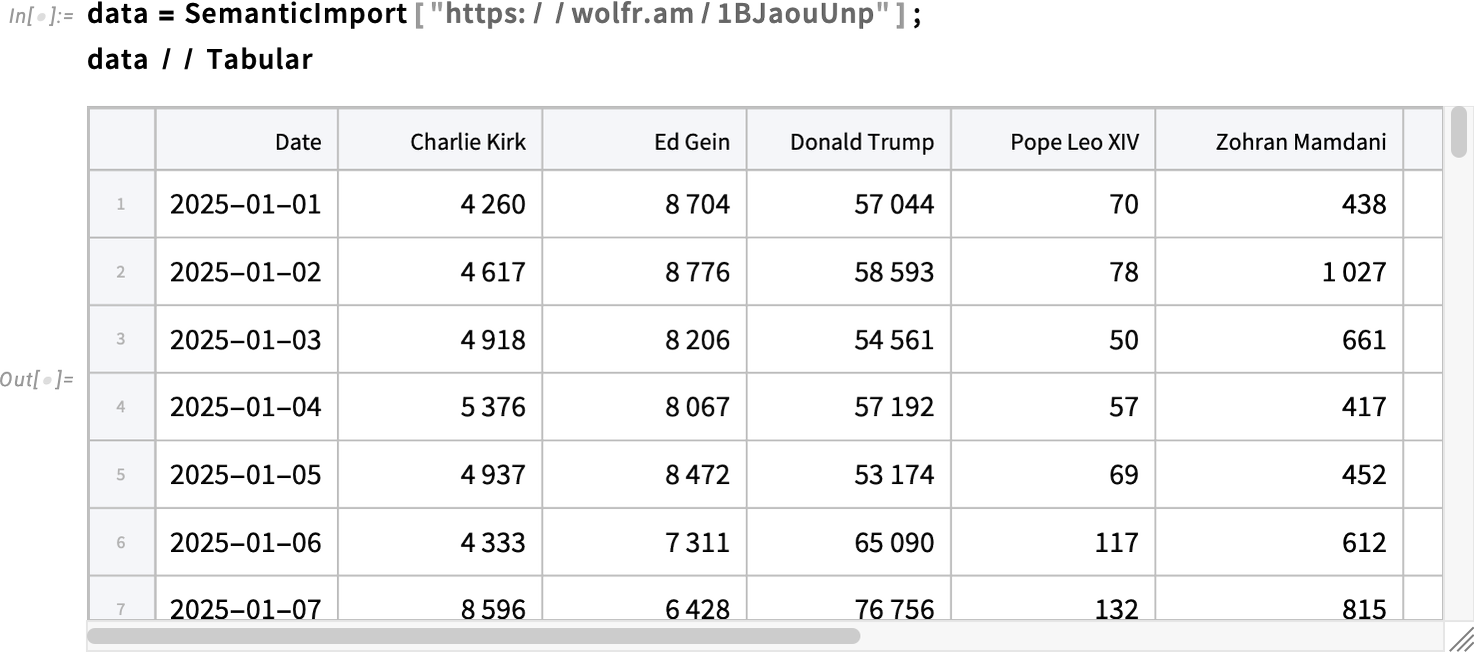
The dates from the dataset form the temporal axis for time series analysis. Each date corresponds to one row of daily pageview counts across all individuals, providing the foundation for tracking how attention evolves over time:

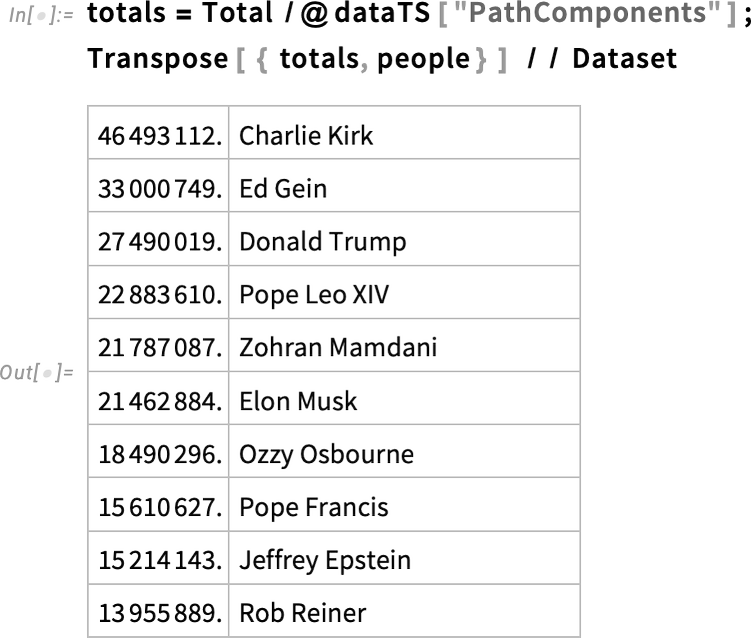
The list of individuals represents public figures who captured significant attention in 2025. Their selection by the Wikimedia Foundation reflects total annual views in 2025, making this a dataset of peak collective attention regardless of the reason—political events, deaths, controversies or cultural moments:
Converting dataset values to numerical form enables the efficient quantitative operations that follow—computing medians, finding peaks and calculating the social memory metric:

The time series object pairs each date with the corresponding pageview vector. This structure enables windowed operations, such as extracting the first and last two weeks of the year for the social memory calculation:

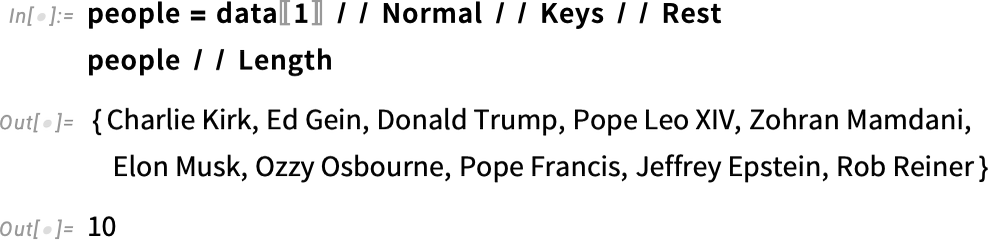
Total annual pageviews provides the simplest measure of 2025 attention magnitude. These totals become the disk sizes in the bubble chart, showing that high total views can arise either from a massive spike (Pope Leo XIV) or from sustained daily interest (Donald Trump):
The 30th percentile captures the baseline attention level—what an article receives on ordinary days without news events. This is the x axis variable (low-day views) in the bubble chart. Lower baselines indicate lesser-known individuals who have more room for memory formation when a catalyst event occurs:

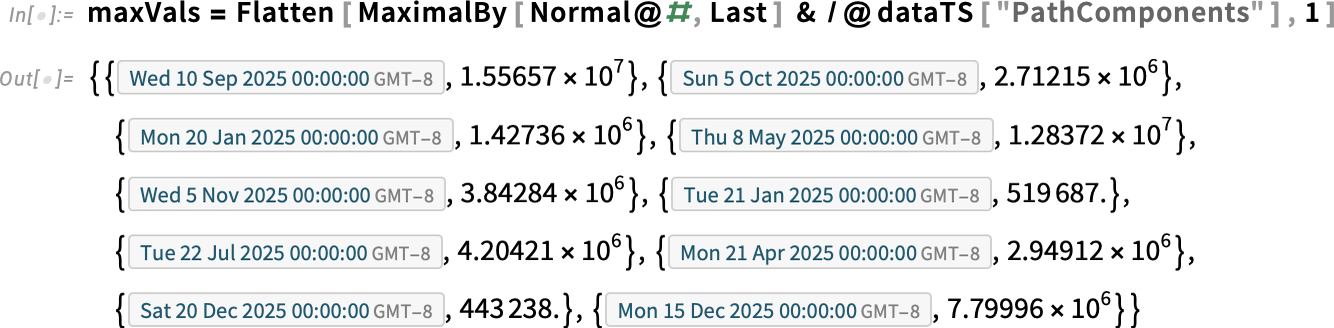
Peak detection identifies the single highest-traffic day for each individual—the catalyst event that drove maximal lookup demand. The date reveals the cause (inauguration, death, election), while the magnitude becomes the y axis variable (max-day views) in the bubble chart:
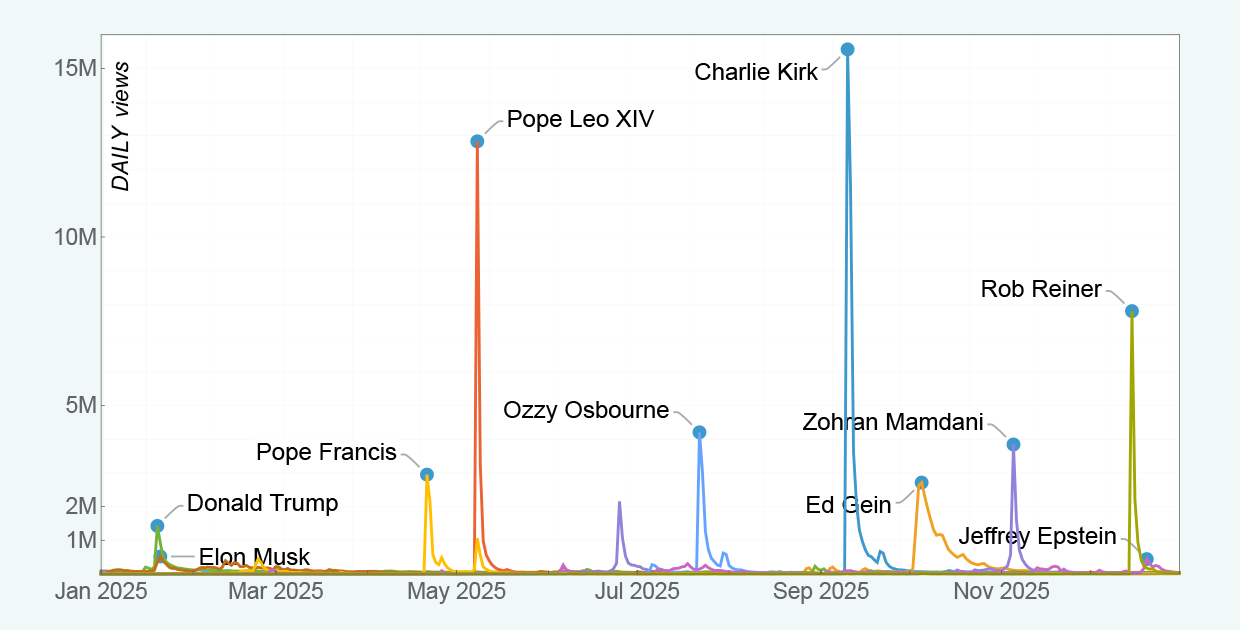
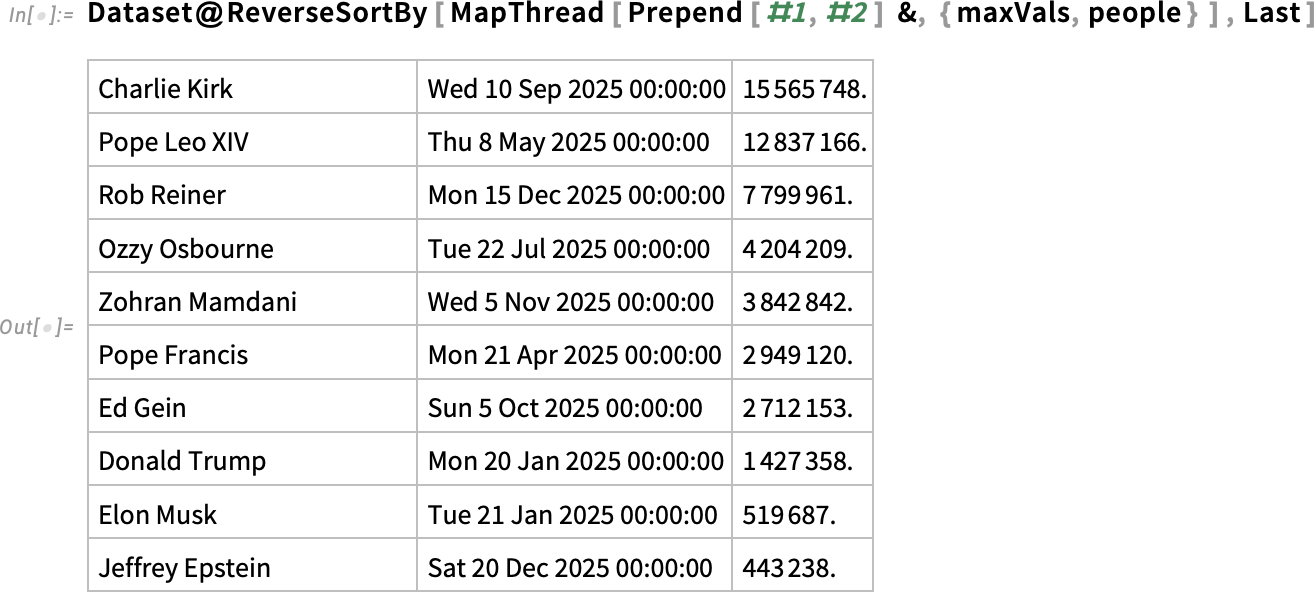
Sorting by peak magnitude reveals the hierarchy of viral intensity. The dataset’s highest single-day totals occur in September (Charlie Kirk) and May (Pope Leo XIV), each above 12 million views. Elon Musk illustrates baseline saturation: sustained, high background attention inhibits the relative size of his single-day peak (520 thousand views):
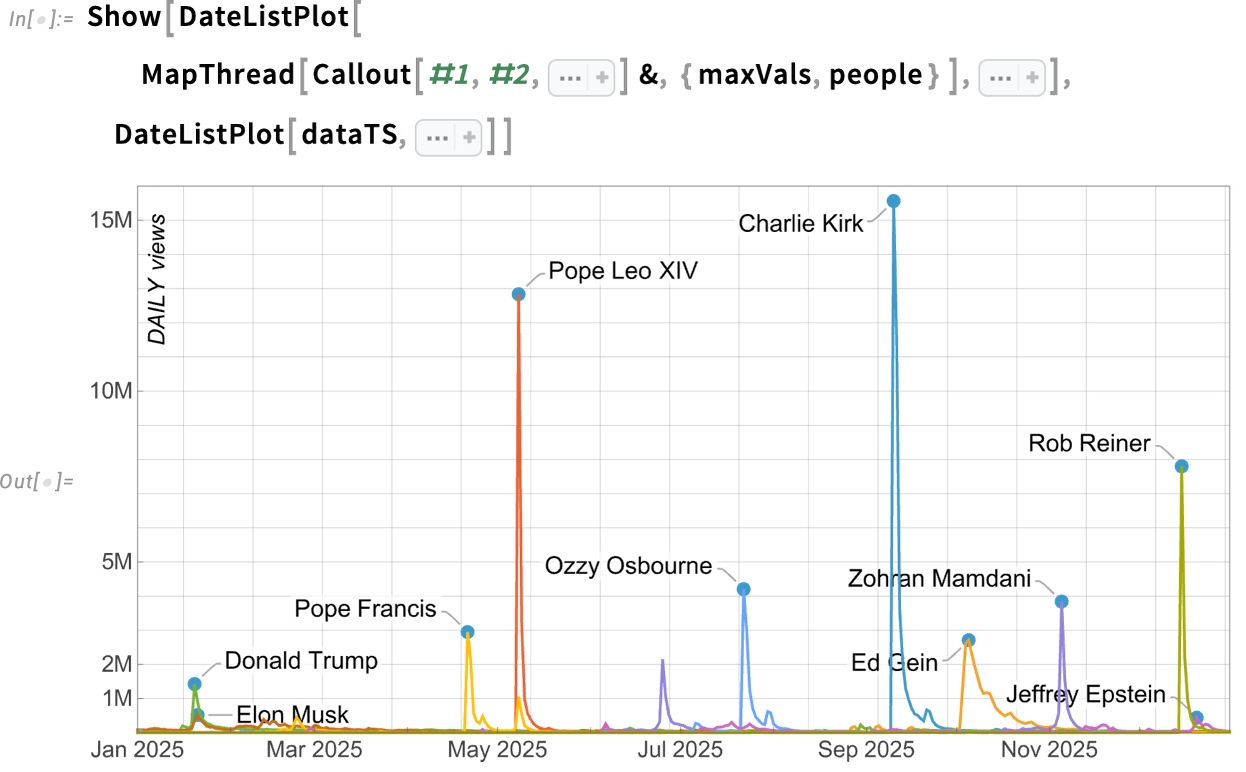
The annotated time series plot shows how peaks distribute across the calendar year. Clustering in January reflects the US presidential inauguration. A few spikes dominate the linear-scale view. Between spikes, most series sit close to the x axis at this scale. The second plot from the top uses log scaling to show the baseline structure between events:
The shift function computes the social memory metric: log₁₀ of the ratio between median daily views in the last two weeks versus the first two weeks of 2025. Positive values indicate the baseline rose (memory formed); negative values indicate decay or unchanged state. This single number quantifies how much lasting attention a catalyst event deposited:

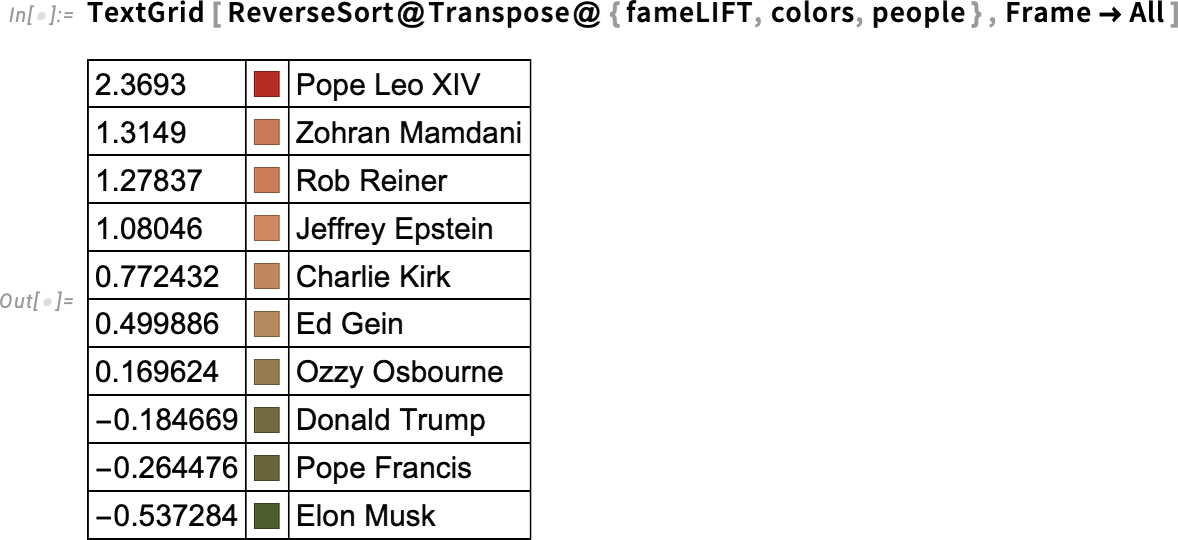
Applying the shift function to each time series produces the social memory values. Pope Leo XIV’s value of 2.37 means his baseline rose by a factor of 102.37 ≈ 234 from January to December—the public now maintains ongoing interest in a figure they barely knew existed in early 2025. Elon Musk’s value of −0.54 indicates baseline decay, consistent with his already-saturated public presence:

The color scale maps lasting impact to a rose-to-green gradient. Red indicates strong memory formation (high positive values) and green indicates an unchanged or decayed baseline (zero or negative values). This encoding makes the bubble chart immediately readable: red-brown-orange bubbles are individuals the public newly learned about; green bubbles are those already known:

The sorted grid confirms the pattern: the top two social memory values belong to Pope Leo XIV and Zohran Mamdani—figures who entered mass awareness through specific 2025 events. The bottom values belong to Pope Francis and Elon Musk—figures whose public presence was already at saturation:
The bubble chart synthesizes all three metrics: baseline views (x axis), peak views (y axis), total views (bubble size) and social memory (color). The log-log scales span three orders of magnitude on each axis, revealing structure that linear scales would compress. The inverse pattern between baseline and peak—high-baseline figures have lower peaks—appears as a downward-sloping trend from left to right. The color gradient confirms that low-baseline figures (left side) show stronger memory imprint (redder), while high-baseline figures (right side) show weaker or negative imprint (greener):
Wikipedia pageviews show two clean patterns. A catalyst event spikes and then it decays, whether back to the old baseline or to a higher new baseline. Social memory measures that difference as a log ratio of pre- and post medians. The top-viewed pages also show baseline saturation: a high, steady baseline inhibits large peak-to-baseline jumps, even when absolute attention stays huge. Word histories, such as “Chernobyl,” show the same imprint shape as attention shifts from an event to a permanent reference point. Wolfram Language makes this analysis reproducible from raw Wikimedia time series to the data visualizations and metrics in one notebook, so readers can test, explore and discover.



Comments